The Complete Guide to What Happens When You Stop Taking Collagen
Quick Answer: Nothing dramatic happens. There is no withdrawal, no rebound, and no crash - collagen peptides are just amino acids, and stopping simply removes an ongoing supply of building material plus a signal that may stimulate your own production. What you should expect is a slow drift back toward your baseline over roughly 8 to 16 weeks, mirroring the timeline it took to see anything in the first place. Skin hydration and elasticity measures tend to fade first, joint comfort more variably, and nails and hair track their own growth cycles so changes appear months later. If you saw no clear benefit while taking it, you will notice nothing at all on stopping - which is itself useful information.
The supplement conversation is almost entirely about starting. The tub runs out, you do not reorder, and six weeks later you are trying to work out whether your knees are worse or whether it is just the weather.

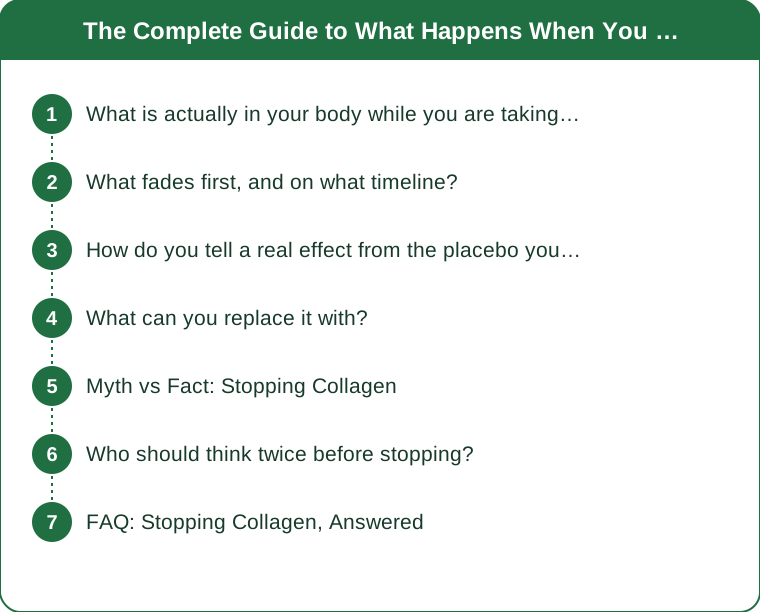
What is actually in your body while you are taking it?
Understanding the exit requires being clear about what the supplement is doing on the way in, and the honest version is less magical than the marketing and more interesting than the cynicism.
Collagen peptides are hydrolysed protein. The manufacturing process breaks whole collagen into short chains of amino acids, mostly di- and tripeptides, small enough to be absorbed intact. When you swallow 10 grams of collagen peptides, you are taking in a protein source unusually rich in glycine, proline, and hydroxyproline - the three amino acids that make up the distinctive repeating structure of collagen.
The first thing that happens is ordinary digestion. The peptides are absorbed and enter circulation. There is no mechanism by which swallowed collagen travels to your face and installs itself in your dermis - that idea is wrong and it is worth discarding before going further, because it makes the actual mechanism harder to see.
The plausible mechanism is twofold. First, substrate: your body builds collagen constantly, and it needs glycine and proline to do it. Glycine in particular is considered conditionally essential, meaning the body makes some but possibly not as much as optimal synthesis requires, and typical modern diets are lower in it than historical ones because we eat less connective tissue, skin, and bone-derived food.
Second, and more interesting, signalling. Research has detected specific collagen-derived dipeptides such as prolyl-hydroxyproline in blood after ingestion, and laboratory work suggests these fragments can act on fibroblasts - the cells that produce collagen - stimulating activity rather than merely feeding it. The working hypothesis is that the body reads circulating collagen fragments as evidence of tissue breakdown and responds by ramping up repair.
Both mechanisms are supply-dependent. Neither involves a permanent structural change to how your body works. Which is precisely why stopping produces a gradual fade rather than a cliff - you have removed an input, not broken a system.
One more thing worth knowing. Collagen peptides are an incomplete protein, low in tryptophan, so they were never functioning as a general protein supplement. If you were counting your 10 grams toward a protein target, stopping removes less than the number suggests.
What fades first, and on what timeline?
The reversal timeline is essentially the mirror image of the onset timeline, which is a useful rule because most people have a rough sense of how long their benefits took to appear.
Skin measures: 8 to 12 weeks to drift back. Trials on skin hydration and elasticity typically run 8 to 12 weeks and show measurable improvement in that window. A small number of studies have included a follow-up period after stopping, and the general pattern is that measures decline toward baseline over a comparable timeframe rather than dropping immediately. Hydration tends to fade before elasticity, since it reflects a more dynamic property.
Joint comfort: highly variable, 4 to 16 weeks. This is where individual experience diverges most. Trials in athletes and in people with activity-related joint pain have generally used 12 to 24 week protocols. Some people report discomfort returning within a month of stopping; others notice nothing for a season. Part of that variability is that joint pain fluctuates enormously anyway with training load, weather, sleep, and body weight - which makes it genuinely difficult to attribute.
Nails: 3 to 6 months to see any change. A fingernail takes roughly 4 to 6 months to grow out completely, and toenails considerably longer. Whatever is happening at the nail matrix today appears at the free edge next spring. If your nails improved on collagen, they will not deteriorate on a timescale you can perceive as connected to stopping.
Hair: 3 to 6 months, same reasoning. Hair growth is cyclical, and any effect on the growth phase shows up long after the change that caused it.
Bone: not perceptible. Studies on bone density and collagen peptides run 12 months or longer and measure changes too small to feel. Stopping is not something you would notice; it would be a matter for a scan years later.
The general shape: the faster a tissue turns over, the faster you notice both onset and reversal. Skin surface hydration is fast; bone is glacial.
The two-week confusion window
Most people who stop report noticing something within one to two weeks. Physiologically that is too fast for tissue-level reversal, and it is much more likely to be attention. Having decided to stop, you now examine your knees, your skin, and your nails daily, which reliably finds things that were always there. Wait at least six weeks before drawing any conclusion, and preferably eight.
How do you tell a real effect from the placebo you were also getting?
This is the most useful question in the whole subject and the one most rarely asked, because the honest answer requires accepting some uncertainty about your own experience.
Placebo effects on joint pain are large. Pain is subjective, modifiable by expectation, and in clinical trials placebo arms in joint pain studies routinely show meaningful improvement. This is not a criticism of anyone who feels better - the improvement is real to the person experiencing it - but it does mean that feeling better on a supplement is weak evidence that the supplement caused it.
Placebo effects on skin appearance are also substantial, particularly because starting a supplement is rarely the only thing that changes. People who begin taking collagen frequently start drinking more water, sleeping better, taking more interest in skincare, and paying attention to sun exposure at the same time.
The stopping test is genuinely the better experiment, and it is the reason this article exists. Onset is confounded by enthusiasm; cessation is confounded by much less, because most people stop for boring reasons - the tub ran out, it got expensive, they forgot.
How to run it properly:
- Write down, before you stop, what you believe it is doing. Be specific: morning knee stiffness, the skin on the backs of my hands, how my nails split. Vague claims cannot be tested.
- Score each one now, 0 to 10. Today, before anything changes.
- Stop, and do not re-score for six weeks. Checking weekly guarantees you will find fluctuation and interpret it as trend.
- Re-score at six weeks and again at twelve, in the same conditions - same time of day, same lighting for skin.
- Consider restarting if two or more measures have moved by 2 points or more. If nothing has moved, you have saved yourself an ongoing expense.
Control for the season, which is the biggest confounder. Joint stiffness genuinely worsens for many people as temperature drops, and skin hydration falls as indoor heating dries the air. Stopping a supplement in late September and concluding it was doing something is a very easy mistake to make. If you can, run the test across a stable season rather than a transition.
A note on cost per apparent benefit. Collagen supplementation at a clinically studied dose is not cheap over a year. If the honest answer after a proper test is that you cannot tell, that is a legitimate reason to stop, and it does not mean the research is wrong - it means the effect size in your case is smaller than your ability to perceive it.

What can you replace it with?
If you decide to stop, or you want to reduce the cost without losing whatever you were getting, there are reasonable substitutes for both mechanisms.
For the substrate mechanism - glycine and proline:
- Bone broth and slow-cooked cuts. Braised shin, oxtail, chicken with the skin, pork belly - anything where connective tissue breaks down into gelatin. This is the historical way humans got these amino acids, and it is genuinely the closest whole-food equivalent. A caveat worth knowing: the glycine content of home-made broth varies enormously with the bones used and the cooking time, so it is not a controlled dose.
- Gelatin. Chemically the same source material as collagen peptides, just not hydrolysed, and typically much cheaper. It does not dissolve in cold liquid and it gels when cool, which limits how you can use it, but in a hot drink or in cooking it delivers a similar amino acid profile.
- Skin-on fish and chicken skin, which are meaningfully high in collagen.
- Glycine itself is available as an inexpensive standalone amino acid. It is also mildly sedating for some people, which is why it appears in sleep formulations.
For collagen synthesis generally, the cofactors matter more than most people realise:
- Vitamin C is non-negotiable. It is required for the enzymatic hydroxylation of proline and lysine - literally the step that makes collagen stable. Without adequate vitamin C, extra amino acids do not help. Deficiency is uncommon but low intake is not, particularly in people eating few fruits and vegetables.
- Adequate total protein. Consistently under-eating protein is a far larger constraint on connective tissue than the absence of a specific supplement.
- Copper and zinc play roles in collagen cross-linking and maturation, and are usually adequate in a varied diet.
For skin specifically, the things with the strongest evidence are not oral:
- Daily sun protection, which prevents the single largest driver of collagen degradation. UV exposure activates enzymes that break collagen down, and this effect dwarfs anything a supplement contributes.
- Topical retinoids, which have decades of evidence for stimulating dermal collagen.
- Not smoking, and moderating alcohol.
For joints specifically:
- Loading the tissue. Tendon and ligament adapt to progressive mechanical load, and structured strength work has stronger evidence for tendon health than any supplement.
- Body weight and training load management, which are unglamorous and dominant.
The honest framing: if you stop collagen and simultaneously start using sunscreen daily and doing two strength sessions a week, you are almost certainly ahead.
Myth vs Fact: Stopping Collagen
Myth: Stopping causes a rebound where your collagen drops below where it started. Fact: There is no mechanism for this and no evidence of it. Collagen peptides are not a hormone, do not suppress your own production through a feedback loop, and do not create dependence. You return toward baseline, not below it.
Myth: You need to taper off. Fact: Nothing to taper. It is a food-derived protein. Stopping abruptly is fine and there is no adjustment period.
Myth: The benefits are permanent once you have built them up. Fact: Skin and connective tissue turn over continuously - dermal collagen has a slow but real turnover, and the gains from supplementation appear to depend on continued intake. This is the same as most nutritional interventions and is not unique to collagen.
Myth: If you did not notice anything when you stopped, it was never working. Fact: Probably, but not necessarily. Effects on bone density or on the rate of change in skin quality over years would be invisible over a twelve-week observation, and the honest position is that the absence of a perceptible change tells you the effect was below your perception threshold, not that it was zero.
Myth: More expensive collagen produces a longer-lasting effect. Fact: Price tracks branding, added ingredients, and marketing far more than it tracks peptide quality. What matters is the dose in grams and whether the type matches the target tissue - type I and III for skin, type II typically studied for joints at much smaller doses.
Myth: You can tell within a couple of weeks of stopping. Fact: Two weeks is inside the attention artefact window, not the physiological one. Anything you notice at two weeks is much more likely to be you looking harder.
Who should think twice before stopping?
For most people this is a low-stakes decision. A few situations warrant more thought.
If you are in a rehabilitation programme. Some protocols for tendon and ligament rehabilitation combine collagen or gelatin dosing with targeted loading, based on research suggesting timing intake before loading may improve the local supply of building blocks during the window when the tissue is being stimulated. If you are mid-programme and it was prescribed as part of it, ask the person who prescribed it rather than stopping unilaterally.
If your overall protein intake is low. Older adults in particular frequently under-consume protein, and while collagen is an incomplete protein it is not nothing. If it was contributing 10 to 20 grams a day to a total that was already marginal, replace it with something rather than simply removing it.
If you eat very little animal protein. Glycine and proline intakes are typically lower on plant-predominant diets, and collagen peptides may have been filling a genuine gap. Legumes, soy, seeds, and gelatin substitutes do not map perfectly onto that profile. Worth being deliberate about the replacement.
If you are recovering from a burn, wound, or surgery. Protein and specific amino acid demands rise substantially during tissue repair, and this is a period to be adding nutrition rather than subtracting it. Follow clinical advice.
If you are peri- or postmenopausal. The decline in oestrogen is associated with a relatively rapid loss of skin collagen in the years around menopause, and this is the population where several of the supplementation trials were conducted. It is not a reason you must continue, but it is a reason the effect may be larger for you than for a 28-year-old, and therefore a reason to run the stopping test carefully rather than casually.
Who can stop without a second thought: anyone who started because of an advertisement, has taken it for under eight weeks, cannot name a specific benefit, or is taking under 2.5 grams a day - which is below most studied doses for skin outcomes and well below the 10 gram doses common in joint and tendon research.
This is general information, not medical advice. If a supplement was recommended to you by a healthcare professional as part of treatment, discuss stopping it with them.
FAQ: Stopping Collagen, Answered
Will my skin suddenly look older?
No. Any change happens over months and is a drift back toward your untreated baseline, not an acceleration past it. The visible ageing driven by sun exposure and time continues at its own rate regardless.
Can I take it seasonally - on in winter, off in summer?
You can, and some people do because dry indoor heating makes skin effects more noticeable in winter. There is no research on cycling, but there is no mechanism that would make it harmful. Expect several weeks of onset each time you restart.
How long should I stay off before I can properly judge?
Eight weeks minimum, twelve is better - and ideally not across a big seasonal transition, which will confound everything.
Is it cheaper to just eat more protein?
Almost always, yes, and if your total protein intake is not already adequate that is the higher-value fix. Collagen is a specific tool for a specific amino acid profile, not a general protein strategy.
Does the type of collagen change how quickly the effect fades?
Not in any documented way. Type I and III are typically studied for skin at doses of 2.5 to 10 grams, and undenatured type II for joints at much smaller doses with a different proposed mechanism. The reversal timeline follows tissue turnover, not supplement type.
If I restart, do I start from zero?
Effectively yes, if you have been off long enough to return to baseline. Expect the same 8 to 12 week onset window you had the first time.
TL;DR:
- There is no withdrawal, rebound, or crash. Collagen peptides are food-derived amino acids, and stopping removes an input rather than breaking a system.
- Expect a gradual drift back to baseline over 8 to 16 weeks, mirroring your onset timeline. Skin hydration fades first; nails and hair follow their own multi-month growth cycles.
- Anything you notice in the first two weeks is attention, not physiology. Wait six to eight weeks before judging.
- Score specific benefits before you stop, re-score at six and twelve weeks, and avoid running the test across a seasonal transition.
- Replacements exist: gelatin and slow-cooked connective tissue for the amino acids, adequate vitamin C for synthesis - and for skin, daily sun protection outperforms any oral supplement.
Stopping is the better experiment than starting, because it is confounded by less enthusiasm. Run it properly once, and you will stop wondering.
Keep Reading
This article is for general informational purposes only and is not medical advice. Always consult a qualified health professional for guidance specific to you.