The Complete Guide to Collagen and Skin: What Changes and What Does Not
Quick Answer: Oral collagen peptides have moderate evidence for small improvements in skin hydration and elasticity over 8-12 weeks at 2.5-10g daily. The effects are real but modest, they do not target your face specifically, and they stop when you stop. Anything promising visible transformation is overselling the data.
Collagen is the most-bought supplement in a category built on hope. It is also one of the few with a reasonable body of human trials — which makes it worth understanding precisely rather than dismissing or believing wholesale.
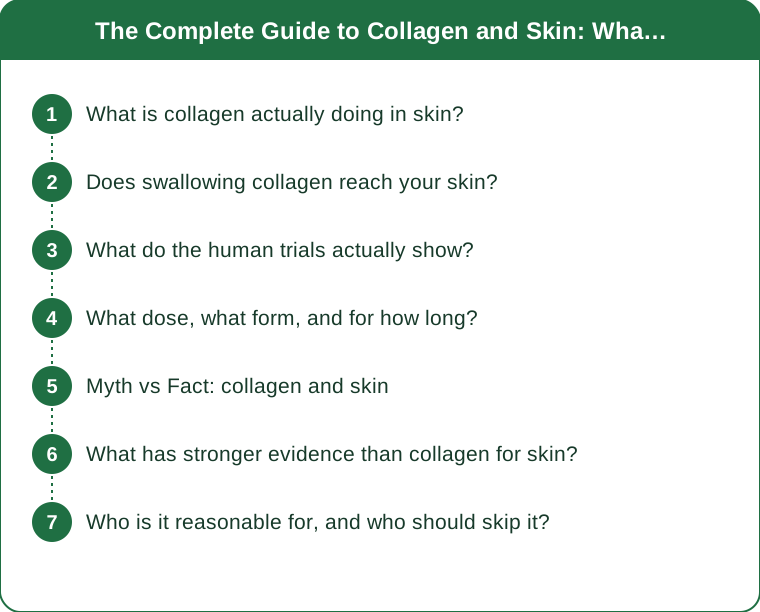
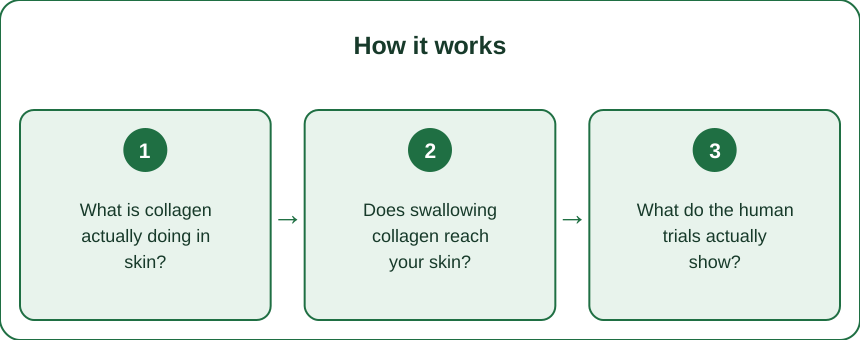
What is collagen actually doing in skin?
Collagen is the structural protein that makes up roughly 70-80% of the dry weight of the dermis, the layer beneath the surface you can see. Types I and III dominate there, arranged in a mesh that gives skin its tensile strength, with elastin providing recoil and hyaluronic acid holding water between the fibres.
From your mid-twenties onward, dermal collagen content declines at somewhere around 1% per year. The decline steepens considerably around menopause — several studies report a loss of roughly 30% of skin collagen in the first five years after menopause, then a slower ongoing decline. That is the single largest change most people will experience, and it is hormonal rather than nutritional.
Alongside the loss of quantity, quality changes. The fibres become more cross-linked and less organised, which reduces elasticity independently of how much collagen is present. Sun exposure accelerates all of it — photoaging is largely a story of degraded dermal collagen and elastin, driven by UV-induced enzymes that break the matrix down faster than it is rebuilt.
So when someone talks about collagen for skin, there are really three separate questions hidden inside: can you slow the loss, can you replace what is lost, and can you improve the organisation of what remains. They have different answers.
Does swallowing collagen reach your skin?
This is the objection people raise first, and it deserves a proper answer rather than a dismissal.
You do not absorb collagen as collagen. Digestion breaks proteins into amino acids and short peptides. The intuitive conclusion — that eating collagen is no different from eating any other protein — is close to right but not quite complete.
What the research has found is that certain small collagen-derived peptides, notably prolyl-hydroxyproline and hydroxyprolyl-glycine, survive digestion intact and appear in the bloodstream after ingestion. These have been detected in plasma within an hour of consumption. Some laboratory work suggests these specific dipeptides may act as signalling molecules — they appear to stimulate fibroblasts, the cells that manufacture collagen in the dermis, rather than simply supplying raw material.
That is the proposed mechanism, and it is plausible. It is also worth being clear about its status: the signalling pathway is supported largely by cell and animal work, and the human evidence sits mainly at the level of outcomes rather than mechanism. We can measure that hydration improved; we are less certain exactly why.
The practical implication is that hydrolysed peptides are the format with the evidence behind them. Gelatin, bone broth, and intact collagen have not been studied to the same standard, and their peptide profile is not the same.
What do the human trials actually show?
This is where being specific matters, because the honest summary is neither dismissive nor enthusiastic.
Several systematic reviews and meta-analyses have now pooled randomised controlled trials of oral collagen peptides for skin. The consistent findings across them are statistically significant improvements in skin hydration and elasticity compared with placebo, typically measured at 8 to 12 weeks, at doses ranging from 2.5g to 10g daily.
Wrinkle depth results are more mixed. Some trials report modest reductions in measured wrinkle depth; others find no significant difference. Where improvements appear, they are small in absolute terms — the kind of change instruments detect reliably and photographs often do not.
Three caveats deserve real weight. First, a large proportion of these trials are industry-funded, which is common in supplement research and does correlate with more favourable outcomes. Second, sample sizes are often modest and study durations short. Third, the measurement tools — corneometry for hydration, cutometry for elasticity — quantify properties that do not always map neatly onto what a person notices in the mirror.
What none of the good trials show is dramatic change. A reasonable reading of the literature is: a real, small, measurable effect on hydration and elasticity, with weaker and less consistent evidence for wrinkles.
What dose, what form, and for how long?
The trial evidence points to a fairly narrow set of practical answers.
Dose: Most positive trials used between 2.5g and 10g of hydrolysed collagen peptides daily. There is no clear dose-response above that range, and the low end has produced positive results in several studies. Paying for 20g doses is not supported by the data.
Form: Hydrolysed peptides — sometimes labelled collagen hydrolysate or collagen peptides. Powder and liquid formats both perform; the format matters less than the fact that it is hydrolysed. Type I and III are the relevant types for skin.
Timing: No convincing evidence that time of day matters. Take it when you will actually remember, which is the variable that genuinely affects outcomes.
Duration: Trials measuring at 4 weeks generally found less than those measuring at 8-12. Twelve weeks is a fair test. Judging it at three weeks tells you nothing.
Persistence: Follow-up data suggests benefits fade after stopping, over a period of weeks to a few months. This is an ongoing intervention, not a course of treatment. That is a meaningful thing to know before starting, because it makes the real question one of long-term cost rather than a one-off trial.
What about the additives? Many products bundle vitamin C, hyaluronic acid, biotin, and a proprietary blend at unstated doses. Vitamin C has a genuine role as a cofactor but only matters if intake is low. Oral hyaluronic acid has some limited supporting evidence for skin hydration, though less than collagen. Biotin has essentially no evidence for skin or hair in people who are not deficient, and it interferes with several common lab tests including thyroid and cardiac markers, which is worth mentioning to your doctor before bloodwork.
On sourcing and quality: supplements are regulated less tightly than medicines in most markets, so third-party testing certification is the practical proxy for what is actually in the tub. Look for a testing mark rather than a marketing claim, and be sceptical of proprietary blends that do not state individual quantities.
One more practical note: collagen is an incomplete protein, low in tryptophan. It should be counted as an addition to your protein intake, not a replacement for a portion of it.
Myth vs Fact: collagen and skin
Myth: Collagen supplements target your face. Fact: Nothing about oral supplementation directs peptides to facial skin. Any effect is systemic — skin everywhere, plus connective tissue elsewhere. The face is simply where you look.
Myth: Marine collagen is absorbed better, so it works better. Fact: Marine collagen does have a lower molecular weight and some evidence of efficient absorption, but head-to-head trials showing superior skin outcomes against bovine peptides are not there. Choose on price, sourcing, and allergy considerations.
Myth: Vitamin C makes collagen supplements work. Fact: Vitamin C is genuinely required as a cofactor for collagen synthesis — but this matters if you are deficient. If your intake is adequate, adding more is unlikely to change the outcome. Many collagen products bundle it as a marketing feature.
Myth: Bone broth is the same thing. Fact: Bone broth contains gelatin with variable and usually modest collagen content, not standardised hydrolysed peptides. It is a food with merits; it is not the intervention that was studied.
Myth: Topical collagen creams do the same job. Fact: Collagen molecules are far too large to penetrate the stratum corneum meaningfully. Topical collagen functions as a humectant on the surface — pleasant, but not structural.
Myth: If it works, results are permanent. Fact: Benefits regress after discontinuation. This is a subscription, not a cure.
What has stronger evidence than collagen for skin?
This is the section most collagen articles leave out, and it is arguably the most useful one.
Sunscreen is the single best-evidenced intervention for skin ageing that exists. A well-known randomised trial in Australia found that daily broad-spectrum sunscreen use produced measurably less skin ageing over 4.5 years compared with discretionary use. No supplement has evidence at that level. If you are buying collagen and not using sunscreen daily, the ordering is backwards.
Topical retinoids have decades of evidence for increasing dermal collagen and improving fine lines, wrinkles, and texture. Prescription tretinoin has the strongest data; over-the-counter retinol is weaker but real. The effect sizes are larger than anything reported for oral collagen.
Not smoking has a substantial, well-documented effect on skin ageing through impaired blood supply and increased matrix breakdown.
Adequate total protein matters more than the specific protein. If you are under-eating protein overall, that is the gap worth closing first.
Sleep and glycaemic control both have supporting evidence, less dramatic but real.
Collagen fits in after all of these. It is a reasonable addition to a foundation, and a poor substitute for one. That framing tends to make people happier with the modest result they get, because they expected a modest result.
Who is it reasonable for, and who should skip it?
Reasonable for: Someone who already uses daily sunscreen, eats adequate protein, and wants a small additional edge on hydration and elasticity — and who can afford it as an ongoing monthly cost for at least twelve weeks. Also reasonable for people who have joint or tendon goals as well, since the evidence base there is separate and somewhat encouraging, which improves the overall value proposition.
Reasonable to skip: Anyone hoping for visible transformation, anyone who would be choosing it over sunscreen or a retinoid, and anyone who cannot sustain the cost long enough to complete a fair trial. Also skip if you have a fish or shellfish allergy and cannot verify the source, or if you have a history of kidney stones and are considering high doses without medical input — hydroxyproline is metabolised to oxalate, and while the practical risk at normal doses appears low, it is worth a conversation.
If you are pregnant, breastfeeding, or managing a chronic condition, check with your doctor before adding any supplement. This is general information, not medical advice.
How to run a fair personal trial: Take a photograph in the same light, same time of day, no makeup, at week 0 and week 12. Change only this one variable. Note how your skin feels, not just how it looks — hydration is the outcome with the most consistent support, and it is something you can actually perceive.
Then make an honest decision at twelve weeks, including the price. Most people who do this properly land on a clear yes or a clear no, which is worth far more than another two years of vague uncertainty.
TL;DR:
- Oral collagen peptides have moderate evidence for small improvements in skin hydration and elasticity at 2.5-10g daily over 8-12 weeks.
- Specific collagen dipeptides do survive digestion and enter the bloodstream; the signalling mechanism is plausible but not fully established in humans.
- Wrinkle-depth evidence is mixed and effect sizes are modest. Much of the research is industry-funded.
- Benefits fade after stopping — treat it as ongoing, not a course.
- Sunscreen, retinoids, not smoking, and adequate total protein all have stronger evidence. Collagen belongs after them, not instead of them.
The fair verdict is that collagen is one of the few supplements in this category with real human data behind it, and also that the data describes something considerably smaller than the marketing does. Run a twelve-week trial with photographs if you are curious, and judge it against the price rather than against the promise. This is general information, not medical advice.
Keep Reading
This article is for general informational purposes only and is not medical advice. Always consult a qualified health professional for guidance specific to you.