The Complete Guide to Stacking Collagen With Your Other Supplements
Quick Answer: Collagen pairs genuinely well with vitamin C, which is required for collagen synthesis, and is best taken together. It stacks neutrally with creatine, vitamin D, magnesium, and omega-3s. It overlaps with whey or other protein powders, so count it toward your total protein rather than on top of it - collagen is an incomplete protein and should not replace a complete source. The one real timing consideration is taking it 30 to 60 minutes before loading the tissue you are targeting, and the one real caution is that a large collagen dose displacing complete protein can leave you short on leucine.
The supplement shelf accumulates. Collagen went on it at some point, then creatine, then vitamin D in the autumn, then magnesium for sleep, and now there is a morning routine involving four scoops and nobody has ever checked whether any of them are working against each other.
Mostly they are not. But there are three genuine interactions worth knowing, and one very common mistake that quietly costs you muscle protein.

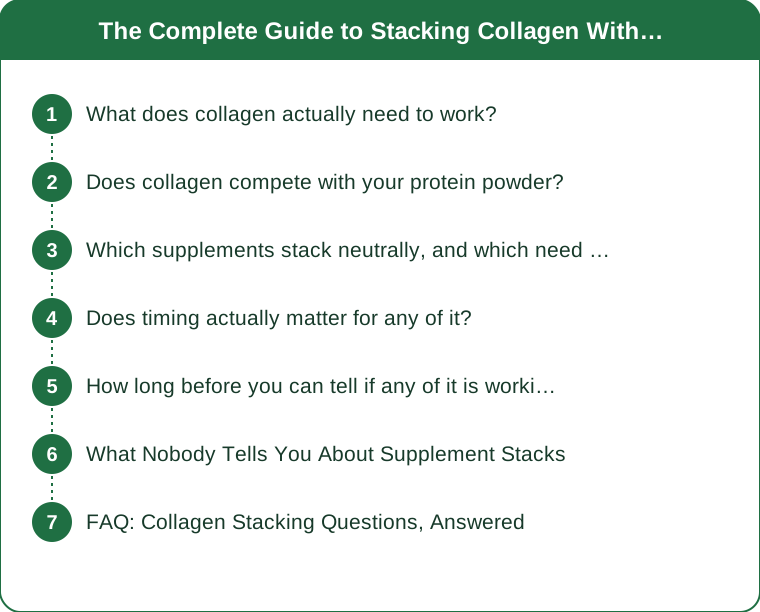
What does collagen actually need to work?
Vitamin C, and this is the one genuine synergy rather than a marketing one.
Collagen synthesis in your body depends on two enzymes - prolyl hydroxylase and lysyl hydroxylase - and both require vitamin C as a cofactor. Without adequate vitamin C, the collagen your body builds is structurally unstable. This is not a supplement-industry claim; it is the mechanism behind scurvy, which is fundamentally a collagen synthesis failure.
So when you take collagen peptides, you are supplying amino acid building blocks - primarily glycine, proline, and hydroxyproline. Vitamin C is what allows your body to assemble them.
Practical implications:
- Take them together. Many collagen products already include vitamin C for this reason. If yours does not, adding 50 to 100mg alongside covers it comfortably - roughly a small orange or half a kiwi.
- You do not need a large dose. The enzymatic requirement is modest, and megadoses of vitamin C do not produce proportionally more collagen. Anything beyond a few hundred milligrams is simply excreted.
- Food sources work fine. Taking collagen with orange juice, berries, or a piece of fruit achieves the same thing as a capsule.
What else is genuinely involved in collagen synthesis:
Copper and zinc act as cofactors in collagen cross-linking. Deficiency impairs it. Supplementing beyond adequacy does not appear to improve it, and excess zinc actively interferes with copper absorption - so this is a case where more is worse.
Protein sufficiency overall. Collagen synthesis draws on your general amino acid pool. A collagen supplement on an inadequate protein intake is a poor use of money.
Adequate calories. Collagen synthesis is downregulated in significant energy deficit. If you are in an aggressive cut, that is doing more to your connective tissue than any supplement is undoing.
Does collagen compete with your protein powder?
They overlap rather than compete, and this is where the most common mistake lives.
Collagen is an incomplete protein. It is very low in tryptophan and, more importantly for anyone training, low in leucine - the amino acid that acts as the primary trigger for muscle protein synthesis.
Whey, by contrast, is roughly 10 to 11 percent leucine and is close to the reference standard for muscle protein synthesis.
The mistake: replacing a whey shake with a collagen scoop and considering it an equivalent protein serving. It is not. You have swapped a highly effective muscle protein source for one that is close to useless in that specific role.
The right mental model: collagen is a targeted supplement for connective tissue, and it counts toward your daily protein total. It is not a substitute for complete protein and it should not be a large share of your intake.
A widely cited limit: keep collagen under about 10 percent of your total daily protein. Above that, the displacement of complete protein starts to matter - and there is some evidence that very high collagen intake as a share of total protein can reduce muscle protein synthesis simply by crowding out better sources.
In practice:
- 15g of collagen and 25g of whey in a day is a sensible split for someone training.
- 40g of collagen and no other supplemental protein is a poor structure.
- Taking them in the same shake is fine. There is no absorption interference between them.
One nuance: if you are taking collagen specifically for tendon or joint reasons, the evidence is stronger for a timed dose around loading rather than for a large total daily amount. More is not the lever here; timing is.
Which supplements stack neutrally, and which need attention?
Most are neutral. Three warrant a note.
Genuinely neutral - take together with no concern:
Creatine. No interaction. Different mechanism, different target. Creatine works on phosphocreatine availability for high-intensity effort and has essentially no relationship to collagen synthesis. Very commonly taken in the same shake and there is no reason not to.
Vitamin D. No direct interaction with collagen. Relevant to bone and muscle in its own right, and worth attention going into autumn at northern latitudes regardless of what else you take.
Magnesium. No interaction. Frequently taken in the evening for sleep, which naturally separates it anyway.
Omega-3s. No interaction with collagen absorption. Some evidence for connective tissue and joint benefits through separate anti-inflammatory pathways, so the pairing is complementary rather than conflicting.
Probiotics. No interaction.
Worth a note:
Iron. Not a collagen conflict, but a classic timing issue with anything else you take alongside. Vitamin C substantially enhances non-heme iron absorption - useful if you are correcting a deficiency, and worth knowing if you are not. Iron is also best away from calcium and from tea or coffee, which is a bigger consideration than the collagen.
Calcium supplements. High-dose calcium can interfere with the absorption of several minerals, including zinc and iron. If you take a calcium supplement plus a mineral-containing collagen product, separate them by a couple of hours.
Zinc, in high doses. Long-term high-dose zinc supplementation impairs copper absorption, and copper is a cofactor in collagen cross-linking. This is only a concern with sustained high-dose zinc, not with a multivitamin.
A note on multivitamins: if you take one plus a collagen product with added nutrients plus individual supplements, check for duplication. Stacked doses of fat-soluble vitamins in particular can add up in ways water-soluble ones do not.
This is general information, not medical advice. If you take prescription medication or have a kidney or liver condition, discuss supplement stacking with a pharmacist or doctor - they can check for genuine interactions specific to you.

Does timing actually matter for any of it?
For collagen and tendons, plausibly yes. For most of the rest, far less than the internet suggests.
The one timing protocol with real support: research on gelatin and collagen for tendon and ligament health has used a dose 30 to 60 minutes before loading the tissue - so before a training session that stresses the relevant structure. The reasoning is that collagen turnover in tendon is stimulated by mechanical loading, and having amino acids and vitamin C available in circulation at that point may support the response. Tendon has poor blood supply, so the window of availability matters more than it would elsewhere.
The evidence here is promising rather than definitive, and it comes largely from small studies. It is also a very low-cost thing to implement, which is why it is worth doing if you are taking collagen for joint or tendon reasons at all.
Timing that does not matter much:
Morning versus evening for skin outcomes. No good evidence for a difference. Take it when you will remember.
With or without food. Collagen peptides are hydrolysed and absorb well either way. Some people report better tolerance with food.
Before or after training for general purposes. Unless you are specifically targeting tendon loading, this is not a meaningful variable.
Timing that does matter for other things in the stack:
- Creatine: total daily intake is what matters, not timing. Consistency beats scheduling.
- Vitamin D: fat-soluble, so absorption improves with a meal containing fat.
- Magnesium: evening for most people, since it is usually taken for sleep.
- Iron: away from calcium, coffee, and tea; with vitamin C.
The practical stack that covers most of this: collagen with vitamin C, 30 to 60 minutes before training, creatine in the same shake, vitamin D with your largest meal, magnesium in the evening. That is one decision made once rather than five decisions daily.
How long before you can tell if any of it is working?
Longer than most people wait, and the timeline differs by target tissue.
Tendon and joint outcomes: studies reporting benefit typically run 12 weeks or more, and some joint pain research runs 24 weeks. Connective tissue turns over slowly - tendon collagen has a very long half-life compared with muscle protein. Judging at six weeks tells you almost nothing.
Skin outcomes: trials reporting improvements in elasticity and hydration generally run 8 to 12 weeks. Effects tend to be modest and measurable rather than dramatic and visible.
Nail and hair: the evidence is thinner. Nail studies have run around 24 weeks, which is roughly one full nail growth cycle - and that duration is a floor, not a suggestion, since you cannot see a change in a nail faster than it grows.
Muscle: collagen is not a useful lever here. If that is your goal, complete protein and resistance training are what move it.
What to actually track:
Pick one specific outcome before you start, because the honest problem with supplement stacks is that you cannot attribute anything when you change five variables at once.
- For joints: a specific activity that currently hurts, rated weekly.
- For skin: a photo in the same light monthly, not daily mirror impressions.
- For tendon: whether a known niggle tolerates a known load.
And the honest framing: collagen is a reasonably well-tolerated supplement with modest, real, but generally small effects in specific applications. It is not doing the work that training load, protein sufficiency, sleep, and time are doing. A stack built on those foundations with collagen as an addition makes sense; a stack substituting for them does not.
What Nobody Tells You About Supplement Stacks
The stack gets built by accretion, and nobody ever audits it.
Each supplement was added for a reason at some point. Almost nobody goes back and asks whether the reason still applies, whether the goal was ever met, or whether two products now overlap. It is entirely normal to find someone taking a collagen product with added vitamin C, a multivitamin with vitamin C, and a separate vitamin C - none of which is harmful, all of which is spending.
Do an audit twice a year. Write down everything, what it is for, and when you started. Anything you cannot justify in one sentence is a candidate for removal. Anything that was started for a temporary reason - a deficiency that has been corrected, a phase of training that ended - probably should have ended with it.
Third-party testing matters more than formulation for most of this. Supplements are regulated less tightly than medicines in most jurisdictions, and independent testing has repeatedly found products whose contents do not match their labels. A certification mark from an independent testing organisation is worth more than an elaborate ingredient list.
The dose on the label is often not the dose in the studies. This is particularly common with collagen - trials showing joint benefit have often used specific doses of specific peptide types, and a product using a different form at a different dose is not the same intervention even though it says collagen on the tub.
And the biggest one: if your stack costs meaningful money each month and you have never verified that any single item is doing anything, the audit will save you more than the next addition will gain you. The base case in supplements is that most of the effect comes from two or three things, and everything else is accumulated hope.
This is general information, not medical advice.
FAQ: Collagen Stacking Questions, Answered
Can I put collagen and creatine in the same shake?
Yes. There is no interaction, and both dissolve fine in water or in a smoothie. Collagen peptides are effectively flavourless, which is why they mix into almost anything.
Should I take collagen on rest days?
If you are taking it for skin or general purposes, daily consistency makes sense. If you are taking it specifically for tendon loading, the dose is tied to training - though taking it daily does no harm and keeps the habit simple.
Does collagen break a fast?
Yes. It is protein and it contains calories, so it will produce an insulin response and break a fasted state in any meaningful sense. If you fast for metabolic reasons, take it with your first meal.
Is marine collagen better than bovine?
The amino acid profiles differ slightly and marine collagen is sometimes claimed to absorb better, but the evidence for a meaningful practical difference is weak. Choose based on dietary preference, cost, and whether the product is third-party tested - those matter more than the source.
Can I take too much collagen?
It is well tolerated at typical doses of 10 to 20g. The real risk of a high intake is not toxicity - it is displacement, where collagen crowds out complete protein and leaves you short on leucine. Keep it under roughly 10 percent of total daily protein.
TL;DR:
- Vitamin C is the one real synergy - it is a required cofactor for collagen synthesis. Take them together, and a modest dose is plenty.
- Creatine, vitamin D, magnesium, and omega-3s stack neutrally. No interaction, no timing conflict.
- Collagen is an incomplete protein, low in leucine. Count it toward your daily total, never as a replacement for whey or other complete protein.
- Keep collagen under about 10 percent of daily protein so it does not displace what actually builds muscle.
- The one timing protocol worth doing: 30 to 60 minutes before loading the tissue you are targeting.
- Expect 12 weeks minimum for joint outcomes, 8 to 12 for skin, and roughly 24 for nails.
- Audit the whole stack twice a year. Most shelves contain at least one duplicated nutrient and one supplement whose reason expired.
The useful question is not what to add next. It is which of the things already on the shelf you could stop taking tomorrow without noticing - and for most stacks, the honest answer is more than one.
Keep Reading
This article is for general informational purposes only and is not medical advice. Always consult a qualified health professional for guidance specific to you.