The Complete Guide to What Collagen Supplements Can and Cannot Do
Quick Answer: The evidence for collagen peptide supplements is moderate for skin hydration and elasticity, and reasonably encouraging for joint discomfort in some populations - with most studies running 8 to 12 weeks at doses around 2.5 to 10 grams daily. It is considerably weaker for hair, nails, bone and everything else marketed alongside them. A meaningful share of the research is industry-funded, which does not invalidate it and does warrant caution about the size of the claimed effects.
It is a large category built on a modest evidence base, and both of those things are true at once.

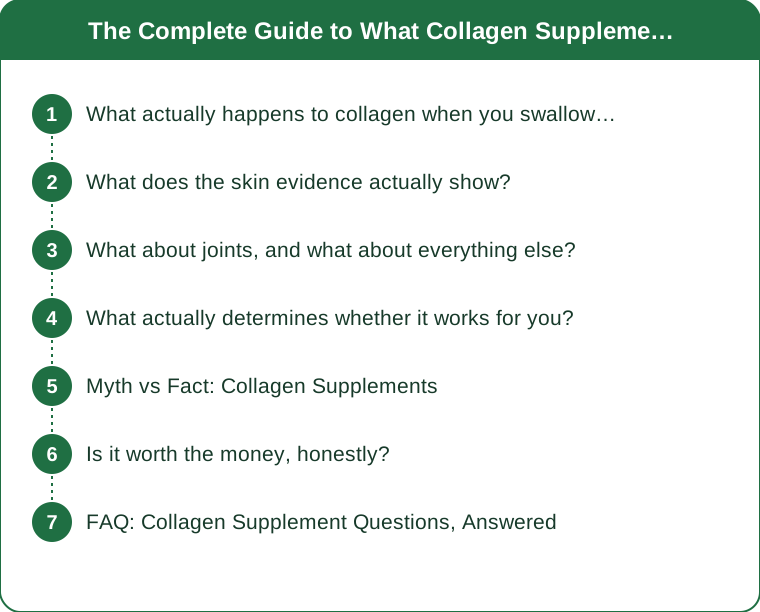
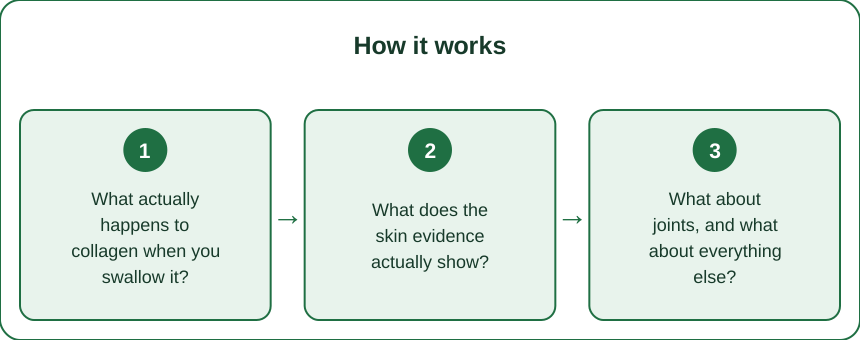
What actually happens to collagen when you swallow it?
This is the objection people raise first, and the answer is more interesting than either side of the argument usually admits.
The naive version of the criticism goes: collagen is a protein, digestion breaks proteins into amino acids, so eating collagen cannot deliver collagen to your skin. The first two parts are correct.
The more accurate picture: hydrolysed collagen is broken into peptides - short chains of amino acids - and some specific collagen-derived peptides do appear to survive digestion and enter the bloodstream intact. Peptides containing hydroxyproline, particularly the dipeptide prolyl-hydroxyproline, have been detected in human blood after collagen ingestion. That is a documented finding, not a marketing claim.
The proposed mechanism is not that these peptides become your skin. It is that their presence may act as a signal to fibroblasts - the cells that produce collagen - stimulating them to increase production. In this model the supplement works as a messenger rather than as a building material.
How well established is that mechanism? Plausible, supported by cell and animal work, and not definitively demonstrated in humans in a way that fully explains the clinical results. It is a reasonable hypothesis rather than settled science.
What this means practically: the simple dismissal - it just gets digested, so it cannot work - is not a sufficient argument, because there are measured outcomes in human trials that need explaining. And the simple endorsement - it rebuilds your collagen - is not supported either. The honest position sits between them, which is an uncomfortable place for a supplement industry to occupy.
One more thing worth knowing: collagen is not a complete protein. It lacks tryptophan and is low in several essential amino acids, which is why it should not be counted toward your protein intake as though it were whey or a food protein.
What does the skin evidence actually show?
This is the strongest area, and it is worth being specific about how strong.
Multiple randomised controlled trials and several meta-analyses have examined collagen peptide supplementation for skin outcomes. The general finding is statistically significant improvements in skin hydration and elasticity compared with placebo, typically over 8 to 12 weeks.
Typical study parameters:
- Dose: roughly 2.5 to 10 grams daily, with many trials clustering around 2.5 to 5g
- Duration: 8 to 12 weeks minimum before differences appear
- Populations: frequently women over 35, which is where age-related collagen decline is measurable
- Outcomes measured: hydration by corneometry, elasticity by cutometry, and wrinkle depth by imaging
The honest caveats, which matter:
A substantial proportion of these trials are funded by collagen manufacturers. This does not automatically invalidate results - industry funding is common across nutrition research - but industry-funded trials across many fields tend to report more favourable outcomes, and it justifies discounting effect sizes somewhat.
Effect sizes are modest. Statistically significant is not the same as visibly transformative, and measurements by instrument do not always correspond to what you would notice in a mirror.
Study durations are short. Most run 8 to 12 weeks. What happens over years is essentially unstudied, which matters for a product people take indefinitely.
Heterogeneity between studies is high - different peptide sources, doses, molecular weights, and outcome measures make pooling difficult and comparisons rough.
A fair summary: there is reasonable evidence of a real but modest effect on skin hydration and elasticity over roughly three months, in the populations studied, with legitimate reasons to be cautious about the magnitude.
What about joints, and what about everything else?
The joint evidence is the second-strongest area. Everything after that thins out quickly.
Joints and joint discomfort. Several trials have found reductions in activity-related joint pain, particularly in athletes and in people with knee osteoarthritis. Doses in these studies commonly run higher than the skin studies - often 5 to 15 grams daily, and some use undenatured type II collagen at much smaller doses through a different proposed mechanism.
The caveats mirror the skin research: modest effects, short durations, meaningful industry funding, and subjective pain outcomes that are inherently more susceptible to placebo effects than instrument measurements are.
Bone density. Some studies suggest small positive effects on bone mineral density in postmenopausal women over 12 months. This is a smaller literature and it warrants more work before firm conclusions.
Hair and nails. Frequently marketed, thinly evidenced. A small number of studies suggest improvements in nail growth and reduced brittleness; hair evidence is weaker still. This is the gap between marketing volume and evidence volume at its widest.
Muscle mass. Some work combined with resistance training in older adults shows benefits, though collagen is an incomplete protein and other protein sources outperform it for muscle purposes.
Gut health. Widely claimed, essentially unevidenced in humans. The mechanism proposed - collagen repairing intestinal lining - is not demonstrated.
Weight loss, sleep, immunity. No meaningful evidence supports these claims.
The pattern to notice: the areas with the most marketing enthusiasm - hair, nails, gut - are among the areas with the least supporting evidence. The two areas with reasonable support are the two that get less airtime because the results are modest and slow.

What actually determines whether it works for you?
Several practical factors, some of which matter considerably more than which brand you buy.
Dose. Below about 2.5g daily there is little supporting evidence for skin outcomes. Many products deliver less than the studied doses, particularly collagen added to drinks and foods as a marketing feature.
Consistency and duration. 8 to 12 weeks minimum, daily. This is the single most common reason people conclude it does not work - they take it for three weeks and stop.
Your starting point. Studies showing the clearest benefit are typically in people with measurable age-related decline - often women over 35 or 40. A 25-year-old with good skin has less room to demonstrate an improvement.
Hydrolysed versus not. Hydrolysed collagen peptides are what the research uses. Gelatin and intact collagen are different products with different absorption characteristics.
Type matters somewhat. Type I and III are the ones studied for skin; type II for joints, often at much lower doses in undenatured form.
What almost certainly does not matter: marine versus bovine source, at least in terms of demonstrated superiority - both are used in successful trials, and claims about marine collagen having superior absorption are not well substantiated. Nor does the addition of vitamin C to a supplement matter if your diet already contains adequate vitamin C, which for most people it does.
What matters more than the supplement: sunscreen. UV exposure is the dominant modifiable driver of collagen degradation in skin, and the effect size of daily sun protection dwarfs anything demonstrated for oral collagen. Smoking is the second. A collagen supplement taken alongside daily unprotected sun exposure is addressing a small variable while ignoring a large one.
Myth vs Fact: Collagen Supplements
Myth: Collagen you eat goes directly to your skin. Fact: It is broken down, and specific peptides do enter the bloodstream and may act as signals to collagen-producing cells. The mechanism is signalling, not delivery - and it is a hypothesis with support rather than an established fact.
Myth: Collagen supplements are just expensive protein. Fact: They are an incomplete protein, so they are worse than most protein sources for muscle purposes. The clinical outcomes in skin and joint trials are not explained by protein content alone, since control groups often receive equivalent protein.
Myth: You will see results in a few weeks. Fact: 8 to 12 weeks is the minimum in the research, and the effects at that point are modest. Anyone promising visible change in a fortnight is not describing what the studies found.
Myth: Marine collagen is significantly better absorbed. Fact: A common marketing claim without strong comparative evidence. Both marine and bovine sources appear in trials with positive results.
Myth: Collagen supplements will replace what ageing takes away. Fact: Collagen production declines with age and the decline is not reversed by supplementation. The demonstrated effects are modest improvements in measured skin properties, not restoration.
Myth: Collagen in your face cream does the same thing. Fact: Collagen molecules are far too large to penetrate the skin barrier meaningfully when applied topically. Topical collagen functions as a surface moisturiser. Retinoids and vitamin C have far better evidence for topically affecting collagen in skin.
Myth: Bone broth is an equivalent natural source. Fact: Bone broth contains collagen in highly variable and generally uncontrolled amounts, and it is not hydrolysed the way study products are. It is a food, and a nice one; it is not a substitute for a measured dose.
Is it worth the money, honestly?
A framework rather than a verdict, since the answer genuinely depends on your situation.
A reasonable case for taking it:
- You are over about 35 and interested in skin hydration and elasticity specifically
- You have activity-related joint discomfort
- You can commit to 8 to 12 weeks at 2.5 to 10g daily, consistently
- The cost is not displacing something with better evidence
- You have realistic expectations of a modest, measurable-rather-than-dramatic effect
A reasonable case for not bothering:
- You are primarily after hair, nail, or gut benefits - the evidence there is thin
- You are not going to take it consistently for three months
- You are not using daily sunscreen, in which case that is an enormously better use of both money and effort
- The budget would otherwise go toward a retinoid, which has far stronger evidence for skin
- You are relying on it as protein intake, which it is poorly suited for
On safety: collagen peptides are generally well tolerated, with mild digestive complaints being the most commonly reported issue. Allergy risk exists with marine collagen for people with fish or shellfish allergies. Supplements are less tightly regulated than medicines, so third-party testing is worth looking for. Discuss supplements with a doctor if you are pregnant, breastfeeding, or taking medication. This is general information, not medical advice.
The most useful reframe: collagen supplements sit in the category of small, plausible, modest-effect interventions. They are not a scam and they are not transformative. If the budget is limited, sunscreen, not smoking, sleep, and a topical retinoid all have stronger evidence for skin than oral collagen does - and none of them are mutually exclusive with it.
FAQ: Collagen Supplement Questions, Answered
How much should I take and when?
Studied doses run roughly 2.5 to 10g daily for skin and often higher for joints. Timing does not appear to matter meaningfully - consistency does.
How long before I know if it is working?
Eight to twelve weeks minimum, taken daily. Judging it at three or four weeks tells you nothing.
Is powder better than capsules or gummies?
Powder is usually the only practical way to reach studied doses. Capsules and especially gummies frequently contain far less than the amounts used in research, and gummies often add sugar.
Does vitamin C need to be taken with it?
Vitamin C is required for collagen synthesis in the body, so adequate intake matters. If your diet contains reasonable vitamin C, adding more alongside a supplement is unlikely to change anything.
Will it help with sagging skin or deep wrinkles?
The measured effects are on hydration and elasticity, with smaller effects on wrinkle depth in some studies. It is not a treatment for structural sagging, and expecting that is where most disappointment comes from.
TL;DR:
- Evidence is moderate for skin hydration and elasticity, and reasonable for joint discomfort in some groups
- Effects are modest, studies are short, and a large share of the research is industry-funded
- Hair, nails, and gut claims are marketed far more than they are evidenced
- 2.5 to 10g daily for 8 to 12 weeks minimum, hydrolysed peptides, taken consistently
- Sunscreen, not smoking, and a topical retinoid all have stronger evidence for skin than oral collagen
Not a scam, not transformative. A small plausible thing, priced like a large one.
Keep Reading
This article is for general informational purposes only and is not medical advice. Always consult a qualified health professional for guidance specific to you.