The Complete Guide to Collagen for Tendons and Connective Tissue
Quick Answer: The tendon research is the strongest area for collagen supplementation, and it has a specific protocol: roughly 15 grams of hydrolyzed collagen or gelatin plus about 50mg of vitamin C, taken 30 to 60 minutes before loading the tissue. The timing is the whole mechanism - tendon blood flow spikes during exercise, and the amino acids need to already be circulating. Taken at a random hour, the evidence is much weaker.
Most collagen marketing is about skin. The tendon and ligament literature is smaller, more specific, and considerably more convincing - and almost nobody follows the protocol it actually describes.

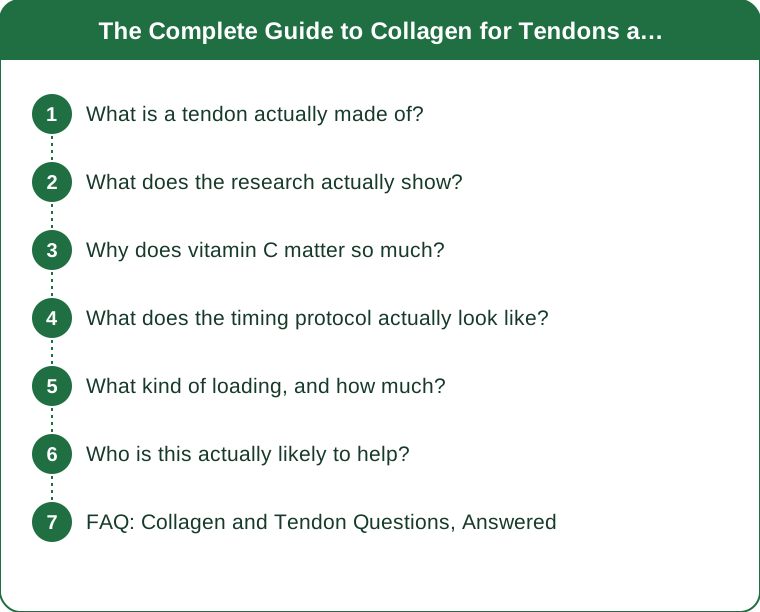
What is a tendon actually made of?
Roughly 65 to 80 percent of a tendon’s dry weight is type I collagen, arranged in a highly ordered hierarchical structure - triple helices bundled into fibrils, fibrils into fibers, fibers into fascicles.
That structure is what gives tendon its tensile strength, and it is also what makes it slow to change. Tendon has a very low blood supply compared to muscle - roughly one seventh the vascularity - and correspondingly slow turnover. Some studies of the Achilles tendon core suggest collagen turnover there is measured in years, not weeks.
This explains two frustrating clinical realities. First, tendon injuries heal slowly and incompletely compared to muscle strains. Second, tendon adaptation to training lags behind muscle adaptation substantially - which is why people who ramp up training quickly develop tendon problems even as their muscles handle the load fine.
The supplementation question follows directly from that. If tendon is mostly collagen and turns over slowly with poor blood delivery, can you improve the raw material supply at the moment blood flow is highest?
What does the research actually show?
The most cited work comes from studies pairing gelatin or hydrolyzed collagen with vitamin C and a short bout of loading.
The design that produced the strongest signal: participants consumed 15 grams of gelatin plus about 50mg of vitamin C, one hour before 6 minutes of intermittent jump rope, three times daily with 6-hour gaps. Blood samples taken afterward showed roughly doubled markers of collagen synthesis compared with placebo.
A follow-up line of work used an engineered ligament model, applying the participants’ blood serum to lab-grown tissue, and found improved mechanical properties in the tissue exposed to serum from the collagen-plus-loading condition.
Other trials have examined activity-related knee pain and Achilles tendinopathy with collagen peptide supplementation alongside rehabilitation exercise, generally reporting improvements in pain and function versus exercise alone - though effect sizes vary and several studies are small or industry-funded.
The honest summary: the mechanism is plausible, the acute biomarker data is fairly consistent, and the long-term clinical outcome data is promising but thinner than the marketing suggests. It is one of the better-supported supplement stories, which is a lower bar than it sounds.
Why does vitamin C matter so much?
Because it is not optional for the chemistry. Vitamin C is a required cofactor for two enzymes - prolyl hydroxylase and lysyl hydroxylase - that hydroxylate proline and lysine residues during collagen synthesis.
Without that hydroxylation, the collagen triple helix is unstable and cannot form properly. This is the actual biochemical basis of scurvy, where connective tissue fails throughout the body.
You do not need a large dose. Around 50mg alongside the collagen is what the studies used, and that is a small orange. Megadosing does not appear to add anything for this purpose, and vitamin C absorption saturates at higher intakes anyway.
The practical version: mix your collagen into orange juice, or take it with a piece of fruit. If you take a vitamin C supplement, take it at the same time as the collagen rather than at a separate point in the day.
One caveat worth knowing: if your diet is already adequate in vitamin C - which most people’s is - the added benefit may be limited. The studies were designed to guarantee sufficiency at the moment of synthesis, not to correct a deficiency.

What does the timing protocol actually look like?
This is where most people get it wrong, and it is the part that matters most.
The mechanism depends on amino acid availability at the moment tendon blood flow is elevated. Exercise increases blood flow to tendon substantially, and that window is when delivery is possible. Peak amino acid concentration in blood after hydrolyzed collagen occurs roughly 30 to 60 minutes after ingestion.
So the protocol is:
- 15 grams of hydrolyzed collagen peptides or gelatin
- Plus 50mg vitamin C (or take it with juice or fruit)
- 30 to 60 minutes before the loading session
- Followed by loading the target tissue - the exercise itself is not optional, it is half the intervention
Taking collagen at bedtime, or with morning coffee unconnected to training, does not reproduce the conditions the research tested. It is not harmful, it is just a different intervention with weaker support.
Some protocols used three doses daily spaced 6 hours apart, each before a short loading bout. That is impractical for most people. One dose before your main session is the realistic version and is what most subsequent work has used.
What kind of loading, and how much?
This part gets skipped and it is arguably more important than the supplement.
Tendon adapts to high-magnitude, long-duration loading - slow heavy resistance training and isometric holds - more than to fast dynamic movement. The parameters that appear repeatedly in tendon research:
- Slow tempo: 3 seconds up, 3 seconds down, or longer
- Heavy loads: roughly 70 to 85 percent of maximum where appropriate
- Sustained tension: isometric holds of 30 to 45 seconds are well supported for tendinopathy
- Frequency: 3 to 4 times per week, with tendon responding to consistency over intensity
For the Achilles that means slow heavy calf raises. For the patellar tendon, slow squats or leg extensions and Spanish squats. For upper body, slow controlled pressing and rowing.
The interaction is the key point: collagen without loading has minimal evidence, and loading without collagen still works. Loading is the primary intervention. The supplement is a possible amplifier of something you have to do anyway.
If you take one thing from this article, take that sentence rather than a shopping list.
Who is this actually likely to help?
Reasonable candidates, based on the current evidence:
People in rehabilitation from a tendon injury who are already doing structured loading work. This is where the clinical trials sit and where the effect, if real, matters most.
People increasing training load quickly - starting a running program, adding volume, returning after a layoff. Tendon adaptation lags muscle adaptation, and that lag is where injuries happen.
Older adults. Collagen synthesis capacity declines with age and tendon stiffness changes, so the raw material argument is stronger.
People with low dietary collagen intake. Collagen comes from connective tissue in food - skin, bones, tougher cuts, bone broth. Modern diets built on lean muscle meat provide very little glycine and proline compared to historical eating patterns.
Less likely to matter much: a well-fed young adult with stable training load and no symptoms. The tissue is probably not raw-material limited.
And a genuine caution: new or worsening tendon pain is a reason to see a physiotherapist, not to buy a supplement. Tendinopathy responds very well to correctly prescribed loading and poorly to guessing. This is general information, not medical advice.
FAQ: Collagen and Tendon Questions, Answered
Is gelatin as good as hydrolyzed collagen peptides?
The foundational studies used gelatin. Hydrolyzed peptides absorb faster and dissolve in cold liquid, which makes them more practical. Both provide the same amino acids; peptides are more convenient and probably reach peak blood levels sooner.
How long before I would notice anything?
Tendon adapts slowly. Studies examining clinical outcomes typically run 3 to 6 months. Anything you notice in two weeks is more likely to be from the loading program than the supplement.
Does bone broth work instead?
In principle it supplies the same amino acids, but concentration varies enormously between batches and most homemade broths fall well short of 15 grams of collagen per serving. It is a fine food, but an unreliable dose.
TL;DR:
- Tendon is 65 to 80 percent type I collagen with very poor blood supply and slow turnover.
- The best-supported protocol is 15g hydrolyzed collagen or gelatin plus 50mg vitamin C, 30 to 60 minutes before loading.
- Vitamin C is a required cofactor for collagen synthesis - small dose, taken at the same time.
- Timing is the mechanism. Collagen taken unconnected to training is a different, weaker intervention.
- Slow heavy loading and long isometric holds are the primary treatment. The supplement is a possible amplifier.
- Most likely to help: rehab, rapid training increases, older adults, and low dietary collagen intake.
If you are going to try this, tie it to the session rather than to breakfast, and do the slow heavy work regardless. This is general information, not medical advice.
Keep Reading
This article is for general informational purposes only and is not medical advice. Always consult a qualified health professional for guidance specific to you.