The Complete Guide to Collagen for Joints and Tendons
Quick Answer: Swallowed collagen is digested into fragments - it does not travel intact to your knee. But small studies suggest a specific protocol may help: 10 to 15 grams of hydrolyzed collagen or gelatin with vitamin C, taken 30 to 60 minutes before loading exercise, appears to increase markers of collagen synthesis, and some trials report reduced activity-related joint discomfort over months. It is a supporting actor: the loading is the stimulus, collagen is raw material timed to meet it. Expect a fair verdict at 12 weeks, not 12 days.
Joints and tendons are where collagen marketing gets most tempting - because tendons literally are collagen, and anyone whose knees comment on stairs would like to mail some there directly. The truth is more conditional than the label and more interesting than the cynics allow. Here is the honest version.

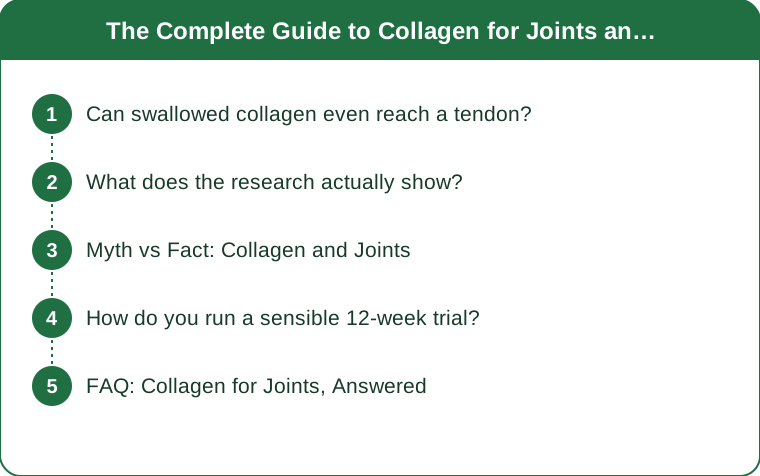
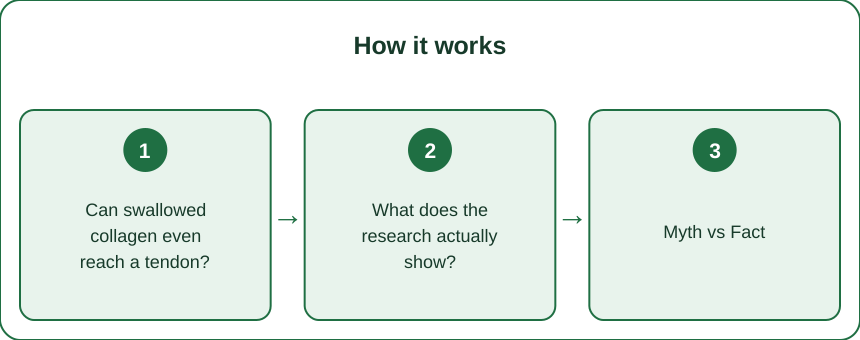
Can swallowed collagen even reach a tendon?
Not as collagen - and understanding what actually happens settles most of the confusion in this space.
Digestion breaks it down. Collagen protein is dismantled in your gut into amino acids and small fragments called peptides, which enter the bloodstream. Your knee never receives collagen; it receives parts and, possibly, messages.
The parts argument. Collagen is unusually rich in three amino acids - glycine, proline, and hydroxyproline - which happen to be the exact building blocks your body uses to manufacture its own collagen in tendons, ligaments, and cartilage. Supplementing raises the circulating supply of that specific raw material, which matters most if your regular protein intake is modest.
The messages argument. Some collagen-specific peptide fragments survive digestion and appear in blood after a collagen dose, and laboratory work suggests certain fragments may act as signals that nudge cells toward collagen production - a plausible mechanism, still being mapped in humans.
The delivery problem no one mentions. Tendons and cartilage have famously poor blood supply - it is why they heal slowly and adapt slowly. Nutrients reach them meaningfully when the tissue is being loaded and moved, with fluid squeezed through by compression and tension. This single fact explains the shape of the entire evidence base: collagen research pairs the supplement with exercise, because without loading, the raw material has no good route in and no order form waiting.
So the honest mechanism is: extra bricks in the bloodstream, possibly a note encouraging construction, delivered during the one window the loading dock is open.
What does the research actually show?
Smaller and more specific than the marketing, more promising than nothing - here is the fair summary.
The timing studies. The best-known line of research gave people about 15 grams of gelatin with vitamin C roughly an hour before short, intense loading exercise, and found increased blood markers of collagen synthesis compared with placebo. It is the study behind the whole take-it-before-training protocol - encouraging, though based on small groups and blood markers rather than photographs of thicker tendons.
The joint comfort studies. Several trials in athletes with activity-related knee discomfort - notably using 5 to 10 grams of hydrolyzed collagen daily over three to six months - reported modest reductions in pain with activity versus placebo. Modest is the operative word: benefits emerged over months and did not transform anyone.
A different product, a different mechanism. Undenatured type II collagen, taken in tiny doses, is studied mainly for knee comfort through an immune-signaling route rather than as raw material - results are mixed but occasionally positive. It is a separate bet from hydrolyzed collagen, not a substitute.
What the research does not show: collagen as a painkiller, collagen replacing rehab, collagen doing anything measurable in people who never load the tissue, or dramatic effects in anyone. Reviews of this literature consistently use words like promising and preliminary - which, in supplement science, is actually a compliment. Most products never get past implausible.
The practical translation: reasonable people can skip collagen entirely and lose little. Reasonable people with cranky tendons who already train consistently can run the protocol and plausibly gain a little. Nobody gets to skip the training part.

Myth vs Fact: Collagen and Joints
Myth: Collagen you swallow becomes collagen in your knee. Fact: It is digested into amino acids and peptides. The case for supplementing rests on raw-material supply and possible signaling - useful, but not a courier service.
Myth: Any collagen, any time of day, works the same. Fact: The tendon-specific evidence is built on timing - collagen plus vitamin C taken 30 to 60 minutes before loading exercise, so elevated building blocks coincide with the tissue being worked. Collagen stirred into evening tea is just protein with good branding.
Myth: Collagen can replace strength work for joint health. Fact: Backwards. Progressive loading is the stimulus that tells tendon to remodel; collagen is, at best, seasoning on that meal. Every positive study feeds both together.
Myth: Vegan collagen contains collagen. Fact: True collagen comes from animal tissue - marine, bovine, porcine. Vegan collagen support products supply some precursor nutrients, which your diet may already cover, but no collagen peptides.
Myth: More grams means more repair. Fact: Studied doses cluster at 5 to 15 grams; nothing suggests 40 grams builds super-tendons, and collagen is an incomplete protein - it lacks tryptophan - so it should never crowd out complete protein sources in your daily total.
Myth: Results should appear within a couple of weeks. Fact: Tendon remodels on a months timescale, and the positive trials ran three to six months. Two quiet weeks means nothing either way.
How do you run a sensible 12-week trial?
If you are going to test it, test it properly - otherwise you are buying expensive uncertainty.
The protocol: 10 to 15 grams of hydrolyzed collagen peptides or plain gelatin, dissolved in anything you like, plus vitamin C - around 50 milligrams, which a glass of orange juice or a supplement covers - taken 30 to 60 minutes before your loading session, on training days at minimum. Daily dosing is reasonable if you prefer routine.
The loading half is not optional. Pair it with progressive work for the tissue you care about: calf raises for Achilles complaints, slow heavy leg work for patellar tendons and knees, gradually built running or hiking volume for general lower-body resilience. Slow, heavy, progressive movement is the actual therapy the collagen is trying to assist. If pain is the reason you are here, get the loading plan from a physical therapist rather than guessing - tendon rehab dosage is a skill.
Measure, because memory lies. Before starting, write down two or three anchors: stairs-in-the-morning discomfort out of ten, how the knee feels the day after your long walk, how deep you can squat without commentary. Re-score every two weeks. At week 12, the notes render the verdict - continue, or spend the money on better shoes.
Choose the boring product. Hydrolyzed collagen peptides, third-party tested, no proprietary blend theatrics. Gelatin from the baking aisle is the budget version of the same amino acids. Marine versus bovine matters for allergies and preference, not results.
Check first if it applies to you: anyone pregnant, anyone with kidney conditions or on protein-restricted diets, and anyone with fish or beef allergies should clear the source with their clinician. And joint pain that is swelling, hot, one-sided, or worsening deserves a diagnosis before a supplement. This is general information, not medical advice.
FAQ: Collagen for Joints, Answered
Does collagen actually help joint pain?
Some trials in active people show modest improvement in activity-related knee discomfort after months of daily use, versus placebo. It is a small, slow, real-looking effect in the research - not a painkiller, and not a substitute for addressing the cause.
When should I take collagen for tendons?
The evidence-based window is 30 to 60 minutes before loading exercise, with vitamin C. That timing puts peak building blocks in your blood while the tendon is being worked - the only time it takes deliveries well.
How much collagen per day for joints?
Studies use roughly 5 to 15 grams of hydrolyzed collagen or gelatin. More is not better - and because collagen is an incomplete protein, it supplements your protein intake rather than replacing real sources.
How long before I know if it is working?
Give it 12 weeks alongside consistent progressive loading, with written symptom scores every two weeks. Tendon adapts on a months timescale; any product promising days is selling something other than physiology.
TL;DR:
- Swallowed collagen arrives as amino acids and peptides - extra bricks and maybe a work order, never a courier to the knee.
- The researched protocol: 10 to 15 grams with vitamin C, 30 to 60 minutes before loading exercise, for months.
- Loading is the therapy; collagen is the assist. No training, no plausible benefit.
- Score your symptoms every two weeks and let week 12 decide - and let complete protein, sleep, and sensible progression stay the headline.
Collagen for joints is a small, honest bet with decent odds and low stakes. Just make it the way the evidence does - clock in hand, calf raises scheduled.
Keep Reading
This article is for general informational purposes only and is not medical advice. Always consult a qualified health professional for guidance specific to you.