The Complete Guide to Collagen, Skin Hydration and What the Evidence Actually Shows
Quick Answer: The evidence for oral collagen peptides is strongest for skin hydration and elasticity, where multiple randomised trials show modest but statistically significant improvements over 8 to 12 weeks at doses of roughly 2.5 to 10 grams daily. The evidence for joint comfort is weaker but not absent. Many trials are industry-funded and use different peptide preparations, so effect sizes should be read cautiously - the direction is more consistent than the magnitude.
Collagen occupies an unusual position: more studied than most supplements, less conclusive than the marketing suggests, and genuinely more interesting than either the enthusiasts or the sceptics allow.

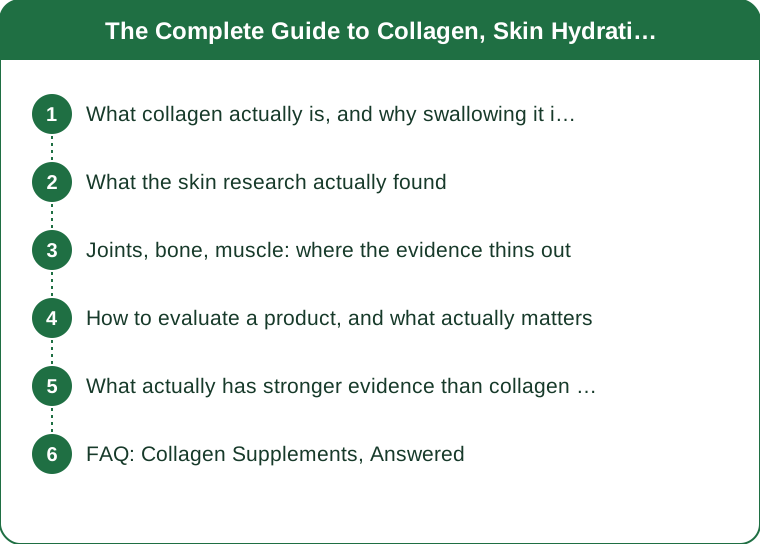
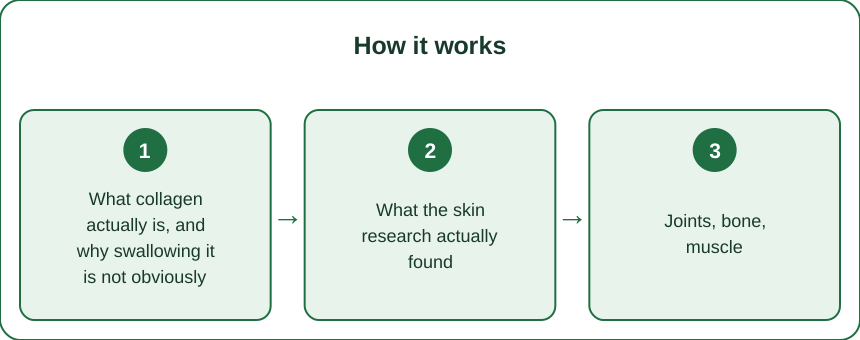
What collagen actually is, and why swallowing it is not obviously useless
The most common objection to collagen supplements is that they are digested into amino acids like any other protein, so taking collagen to build collagen makes no more sense than eating a fingernail to grow nails. That objection is partly right and partly outdated.
What collagen is. It is the most abundant protein in the human body, forming the structural framework of skin, tendon, ligament, cartilage and bone. In skin, type I collagen makes up the large majority of the dry weight of the dermis. It provides tensile strength; elastin provides recoil; hyaluronic acid holds water between them.
What happens with age. Dermal collagen density declines gradually from the mid-twenties onward, with estimates around 1 percent per year, accelerating after menopause. The decline is compounded substantially by UV exposure, which activates enzymes that degrade existing collagen. Photoageing accounts for a large share of visible skin ageing, which is why sun protection outperforms every supplement on the market.
Why the digestion objection is incomplete. Collagen supplements are not intact collagen - they are hydrolysed collagen peptides, broken into short chains of two or three amino acids. Research has found that certain of these dipeptides and tripeptides, particularly proline-hydroxyproline, can be absorbed intact and detected in the bloodstream after ingestion.
The proposed mechanism, which is plausible and not fully established, is that these circulating peptides act as signalling molecules rather than as building blocks - potentially stimulating fibroblasts to increase collagen and hyaluronic acid production. In other words, the effect may be informational rather than nutritional.
Why this matters for how you read the evidence: if the mechanism is signalling, then the specific peptide profile matters, dose matters, and different products may genuinely not be interchangeable. This is also why trial results vary between preparations - they are not all testing the same thing.
What collagen is not. It is a poor-quality protein by conventional measures, low in several essential amino acids and lacking tryptophan entirely. It should not be counted toward your daily protein target as if it were whey or a complete food protein. If you are taking it, take it in addition to adequate protein, not instead of some.
What the skin research actually found
This is where the evidence is most substantial, and it is worth looking at what was measured rather than what was claimed.
The general shape of the literature. Multiple randomised, placebo-controlled trials have tested oral collagen peptides for skin outcomes, and several systematic reviews and meta-analyses have pooled them. The consistent findings are improvements in skin hydration and elasticity, with more variable findings for wrinkle depth.
Typical trial parameters:
- Dose: commonly 2.5 to 10 grams per day. Several well-known trials used 2.5 grams of specific bioactive peptides; others used 5 or 10 grams of general hydrolysate.
- Duration: 8 to 12 weeks most commonly, with some running to 6 months
- Population: frequently women aged 35 to 65
- Measures: corneometry for hydration, cutometry for elasticity, and imaging for wrinkle depth
What the pooled analyses tend to show:
- Hydration: the most consistent positive finding across studies
- Elasticity: consistently improved, with moderate effect sizes
- Wrinkle depth: improvements reported in several trials, less consistently across the whole literature
The important caveats, stated honestly:
- A large proportion of these trials are funded by collagen manufacturers. This does not make results invalid, but industry funding is associated with more favourable outcomes across nutrition research generally, and it warrants discounting the effect sizes somewhat.
- Different products use different peptide profiles from different sources - bovine, marine, porcine - with different molecular weights. Results from one preparation do not automatically transfer.
- Effect sizes are modest. These are measurable instrument-detected changes, not dramatic visible transformation. Someone expecting a visible difference a stranger would notice is likely to be disappointed.
- Sample sizes are often small, in the range of 50 to 120 participants, which limits precision.
What is reasonable to conclude: there is a real, replicated, modest effect on measured skin hydration and elasticity in the studied populations at the studied doses. That is a genuinely better evidence base than most supplements have, and it is also considerably less than the marketing implies.
Joints, bone, muscle: where the evidence thins out
The claims extend well beyond skin, and the evidence does not extend equally.
Joint comfort. Several trials have examined collagen peptides for activity-related joint pain, including in athletes and in people with osteoarthritis. Some show statistically significant reductions in reported pain, typically at doses around 10 grams daily over 3 to 6 months.
- The evidence is weaker than for skin - fewer trials, more heterogeneity, and pain is a subjective outcome with substantial placebo response
- Undenatured type II collagen is a distinct preparation, used at much smaller doses of around 40 milligrams, with a proposed immune-mediated mechanism. It should not be conflated with hydrolysed peptides - it is a different intervention entirely.
- The realistic read: possibly helpful for some people with activity-related joint discomfort, not established, and not a substitute for loading and strengthening the joint, which has far stronger evidence
Tendon and ligament. An interesting emerging area. Some research suggests collagen peptides taken with vitamin C roughly an hour before loading exercise may support connective tissue adaptation, based on the observation that collagen synthesis rises after mechanical loading.
- The studies are small and mostly short-term
- The timing element - taking it before rather than after exercise - is a distinctive feature of this protocol and is based on the window of increased blood flow and synthesis
- Treat this as promising rather than established
Bone density. A small number of trials, including one running over 12 months in postmenopausal women, have reported improvements in bone mineral density with collagen peptide supplementation. This is an interesting signal from a limited base, and it does not displace the established interventions - resistance training, adequate protein, calcium and vitamin D.
Muscle mass. Collagen is a poor protein for muscle protein synthesis, being low in leucine. Trials showing benefit have generally combined it with resistance training, and the effect is likely attributable to the training and total protein rather than to anything collagen-specific.
Hair and nails. The weakest area. A small number of trials report improved nail growth and reduced breakage; hair evidence is very limited. This is the claim with the largest gap between marketing volume and evidence.

How to evaluate a product, and what actually matters
If you decide to try it, the details that matter are not the ones on the front of the tub.
Dose and form:
- Hydrolysed collagen peptides, not gelatin and not ‘collagen protein’ with unclear processing
- A dose in the studied range - 2.5 to 10 grams daily for skin outcomes, toward 10 grams for joint claims
- Check the serving size against the studied dose. Products delivering under a gram per serving are not delivering what the trials used.
Type and source:
- Type I and III predominate in skin; type II in cartilage
- Bovine hydrolysate is mostly type I and III; marine is predominantly type I with somewhat lower molecular weight; porcine is similar to bovine
- Marine collagen is often marketed as superior for absorption. The molecular weight difference is real; the clinical superiority is not well demonstrated.
Third-party testing:
- Supplements are regulated less tightly than medicines in most markets, and content verification is not guaranteed
- Look for independent testing marks, particularly relevant for anyone subject to drug testing in sport
- Heavy metal testing matters for marine sources in particular
Additions to ignore and one to consider:
- Vitamin C is genuinely relevant - it is a required cofactor for collagen synthesis, and several protocols include it. It is also cheap and easily obtained from food.
- Hyaluronic acid, biotin and long botanical lists add cost and marketing copy more than demonstrated effect
- Flavoured products with substantial added sugar are worth checking
Practical use:
- Consistency over months, not weeks. Trials generally show effects from 8 weeks, with continued improvement to 12.
- Timing is mostly irrelevant for skin outcomes. For tendon protocols specifically, an hour before loading is the studied approach.
- Dissolve in anything. Peptides are heat stable enough for coffee.
What to expect, honestly: modest measurable changes in hydration and elasticity, most noticeable to you rather than to others, developing over two to three months. If nothing has changed after 12 consistent weeks at an adequate dose, it is reasonable to stop.
Safety and who should be cautious: collagen peptides are generally well tolerated, with mild digestive complaints the most commonly reported issue. Anyone with a fish or shellfish allergy should avoid marine sources. People who are pregnant or breastfeeding, have kidney disease, or take regular medication should speak to a healthcare professional first. This is general information, not medical advice.
What actually has stronger evidence than collagen for skin
Worth stating clearly, because the opportunity cost of supplement spending is real.
Daily sunscreen. Photoageing accounts for a large majority of visible skin ageing on sun-exposed areas. The evidence that regular sunscreen use slows visible skin ageing includes randomised controlled trial data, and the effect size dwarfs anything an oral supplement has shown.
Topical retinoids. The most robustly evidenced topical intervention for photoageing, with decades of trial data showing improvement in fine lines, pigmentation and dermal collagen. Prescription strengths have the strongest evidence; over-the-counter retinol is weaker but not negligible.
Not smoking. Smoking accelerates skin ageing through several mechanisms including collagen degradation. The effect is visible and well documented.
Adequate total protein and overall nutrition. Collagen synthesis requires amino acid availability, and many people, particularly older adults, fall short of optimal protein intake. Fixing that is more foundational than adding a specific peptide.
Sleep and stress management, both of which affect skin barrier function and repair.
Where collagen sits in that hierarchy: as a reasonable addition once the foundational items are in place, with a modest evidence base and a modest expected effect. Not as a substitute for any of them.
A fair summary position: collagen peptides are among the better-evidenced supplements in the beauty category, which is a low bar cleared genuinely rather than dramatically. If you can afford it and you take it consistently for three months, there is reasonable evidence you will see a measurable improvement in skin hydration and elasticity. If that budget would otherwise go toward sunscreen, a retinoid, or simply more protein in your diet, those have stronger claims on it.
FAQ: Collagen Supplements, Answered
Does collagen actually survive digestion?
Not as intact collagen. It is hydrolysed into short peptides, and research has found certain dipeptides can be absorbed intact and detected in blood, which is the basis of the proposed signalling mechanism.
How long before I would see anything?
Trials generally show measurable changes from 8 weeks, with continued improvement to around 12. If nothing has changed after 12 consistent weeks at an adequate dose, stopping is reasonable.
What dose does the research use?
Commonly 2.5 to 10 grams daily for skin outcomes, with joint studies using around 10 grams. Check the serving size on your product against that range.
Is marine collagen better than bovine?
Marine has a somewhat lower molecular weight and is predominantly type I, but clinical superiority is not well demonstrated. Avoid marine sources if you have a fish or shellfish allergy.
Can I count collagen toward my daily protein?
No. It is incomplete, low in essential amino acids and contains no tryptophan. Take it in addition to adequate protein, not as part of it.
Does it help joint pain?
Some trials report reduced activity-related joint pain at around 10 grams daily over several months, but the evidence is weaker than for skin and pain outcomes carry a large placebo response. It is not a substitute for strengthening the joint - speak to a healthcare professional about persistent joint pain. This is general information, not medical advice.
TL;DR:
- Collagen peptides are hydrolysed into short chains, some of which are absorbed intact and may act as signals
- The strongest evidence is for skin hydration and elasticity - modest, replicated, mostly industry-funded
- Effective doses in trials are 2.5 to 10 grams daily over 8 to 12 weeks
- Joint evidence is weaker; hair and nail evidence is weakest; it is a poor protein for muscle
- Sunscreen, retinoids and adequate total protein all have stronger evidence for skin than any supplement
Collagen is one of the better-evidenced supplements in a category with a low bar. Modest, real, and worth trying if the foundational things are already handled - which is a genuinely different claim from the one on the packaging.
Keep Reading
This article is for general informational purposes only and is not medical advice. Always consult a qualified health professional for guidance specific to you.