How to Actually Support Your Body's Collagen (Without Buying a Single Supplement)
Quick Answer: Collagen production depends more on vitamin C, adequate protein, and sun protection than on any supplement — your body can’t build collagen without vitamin C as a cofactor, no matter how much collagen powder you add.
The supplement aisle makes it look like collagen comes in a tub. Your body’s actually been building its own since before you could read a label — it just needs the right raw materials to keep doing it well.

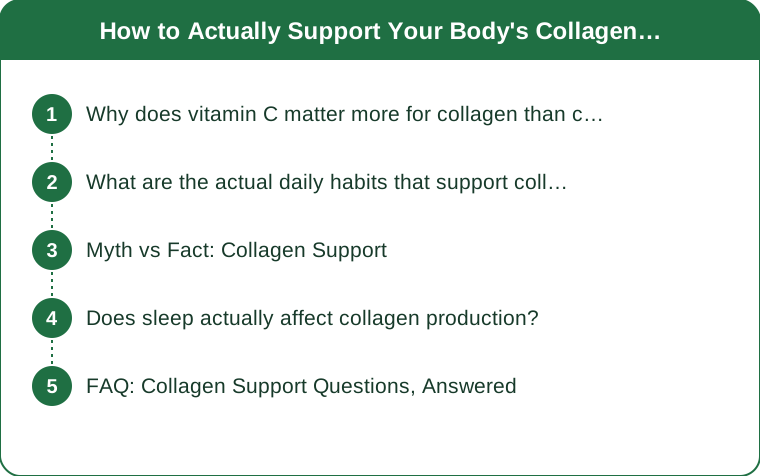
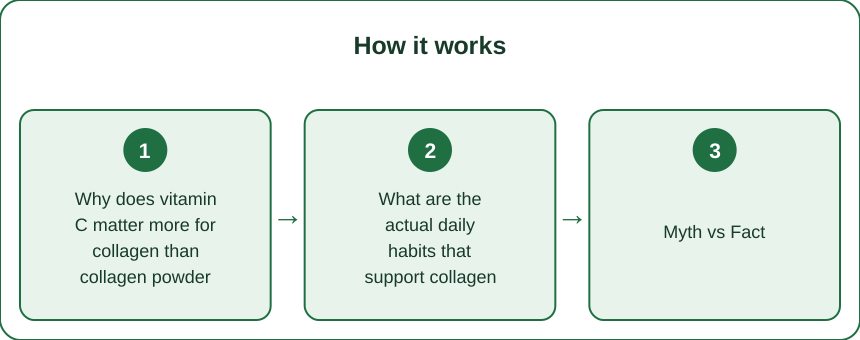
Why does vitamin C matter more for collagen than collagen powder itself?
Because vitamin C is a required cofactor for the enzymes that stabilize collagen’s molecular structure. Without enough vitamin C, your body can have all the amino acid building blocks it needs and still can’t assemble them into functional collagen.
This is why classic vitamin C deficiency (scurvy) causes connective tissue breakdown — it’s a collagen problem at its root, not a protein problem.
What are the actual daily habits that support collagen production?
1. Enough protein, spread through the day — collagen is built from amino acids, particularly glycine and proline, found in a normal varied protein intake.
2. Vitamin C from food — citrus, bell peppers, and strawberries all supply meaningfully more than most people get from diet alone.
3. Daily sunscreen — UV exposure directly breaks down existing collagen through an enzyme called collagenase; this is the single biggest controllable factor in visible skin collagen loss.
4. Limiting added sugar — excess sugar can bind to collagen fibers in a process called glycation, making them stiffer and less elastic over time.

Myth vs Fact: Collagen Support
Myth: Collagen supplements are absorbed as intact collagen. Fact: Collagen is broken down into amino acids and peptides during digestion, just like any other protein — your body doesn’t absorb ‘collagen’ as such, it absorbs the building blocks and reassembles them if it has what it needs.
Myth: Only middle-aged skin needs collagen support. Fact: Collagen production begins its gradual decline in your mid-to-late 20s — sun protection habits started earlier have a compounding effect.
Myth: Bone broth is a collagen powerhouse. Fact: Bone broth’s actual collagen/protein content varies wildly by batch and cook time — it’s a reasonable food, not a reliable dosing method.
Does sleep actually affect collagen production?
Yes — most of your body’s tissue repair, collagen synthesis included, happens preferentially during deep sleep stages. Chronic short sleep (under 6 hours regularly) has been associated with measurably reduced skin repair markers, making consistent sleep one of the more overlooked collagen-support habits.
FAQ: Collagen Support Questions, Answered
Do collagen supplements do anything at all?
Some studies show modest skin elasticity improvements with consistent use over 8-12 weeks, but they work alongside — not instead of — the foundational habits above.
What’s the single most impactful habit for collagen?
Daily sunscreen, hands down — it’s the most direct, controllable defense against the biggest known driver of collagen breakdown.
Can you get too much vitamin C for collagen purposes?
Excess vitamin C beyond what your body uses is simply excreted — food sources make overdoing it very unlikely.
TL;DR:
- Vitamin C is a required cofactor — no amount of collagen powder works around a vitamin C gap
- Daily sunscreen is the single most controllable defense against collagen breakdown
- Limit added sugar; glycation stiffens existing collagen fibers over time
- Sleep matters — most tissue repair happens in deep sleep stages
This is general information, not medical advice — but the highest-leverage collagen habit is sitting in your bathroom cabinet, not the supplement aisle.
Keep Reading
This article is for general informational purposes only and is not medical advice. Always consult a qualified health professional for guidance specific to you.