Collagen: What Works, What's Hype and What Your Money Buys
Collagen is the supplement aisle’s reigning celebrity: in the coffee, in the gummies, in approximately every influencer’s morning routine. The evidence is more interesting than both the hype and the backlash — some real findings, some marketing fog. Here’s where your money actually goes.

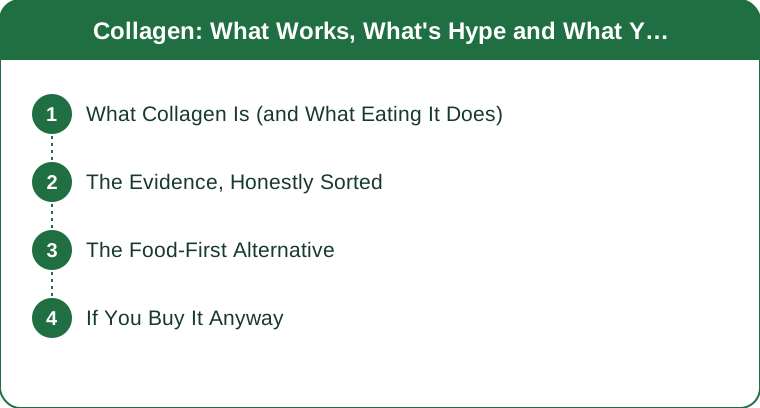
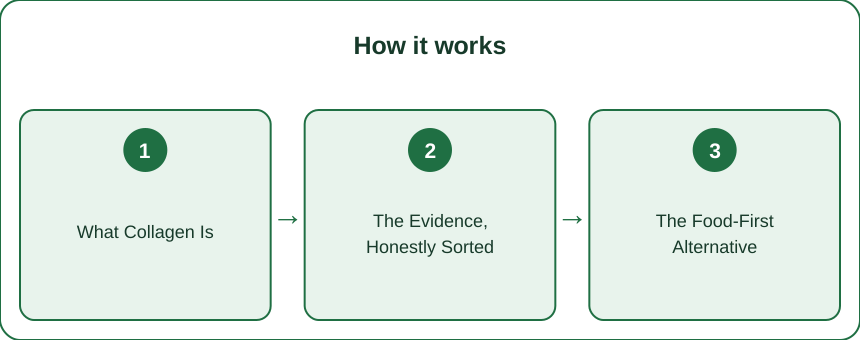
What Collagen Is (and What Eating It Does)
The biology: collagen is the body’s structural protein — skin, tendons, joints — and production drifts down from our mid-twenties. The catch everyone should know: swallowed collagen doesn’t travel to your face like a courier; it’s digested into amino acids and peptides. The interesting part: those specific peptides MAY signal collagen-producing cells to work harder — that’s the mechanism the supplement research hangs on, and it’s plausible rather than proven-beyond-doubt.
The Evidence, Honestly Sorted
The stronger column: multiple trials on hydrolyzed collagen peptides show modest improvements in skin hydration and elasticity after 8-12 weeks, and some joint-comfort findings in active people — modest, gradual, real-ish (with the caveat that much research is industry-funded; grains of salt included free). The weaker column: hair, nails, gut claims and anything promising visible transformation in a fortnight. The pattern: small effects, long timelines, consistency required.

The Food-First Alternative
The unmarketed truth: your body builds collagen from protein plus vitamin C — so adequate daily protein (the thing most women actually under-eat), vitamin-C-rich produce, and the classic sources (bone broth, skin-on fish) support the same machinery. And the biggest collagen intervention isn’t edible: sun protection — UV degrades collagen faster than any supplement rebuilds it. Sunscreen is the best collagen product on the market, at a fraction of the price.
If You Buy It Anyway
The label literacy: look for ‘hydrolyzed collagen peptides’ (the studied form), a research-aligned dose (commonly 2.5-10g daily), third-party testing (it’s an animal-derived product; purity matters), and skip the pixie-dust products where collagen is the twelfth ingredient in a gummy. Give it a genuine 8-12 week run alongside the boring pillars — protein, SPF, sleep — and judge by your own before-and-after rather than the jar’s promises. Verdict: a ‘maybe-helpful extra’, never a foundation.
Peptides maybe, protein definitely, sunscreen absolutely. Collagen the supplement is a modest supporting actor — the lead roles were always protein and SPF, and they’re cheaper.
Keep Reading
This article is for general informational purposes only and is not medical advice. Always consult a qualified health professional for guidance specific to you.