Why Third-Party Testing Matters More Than the Collagen Source on the Label
Quick Answer: Collagen source (marine, bovine, or plant-based collagen boosters) mostly determines amino acid profile and dietary compatibility, but third-party testing certification is the stronger predictor of whether a product actually contains the labeled dose without contaminants — a collagen supplement without any independent testing verification carries meaningfully more uncertainty than one that has it, regardless of source quality.
Most collagen marketing focuses heavily on source, but the supplement industry’s biggest quality gap is actually in verification, not sourcing.

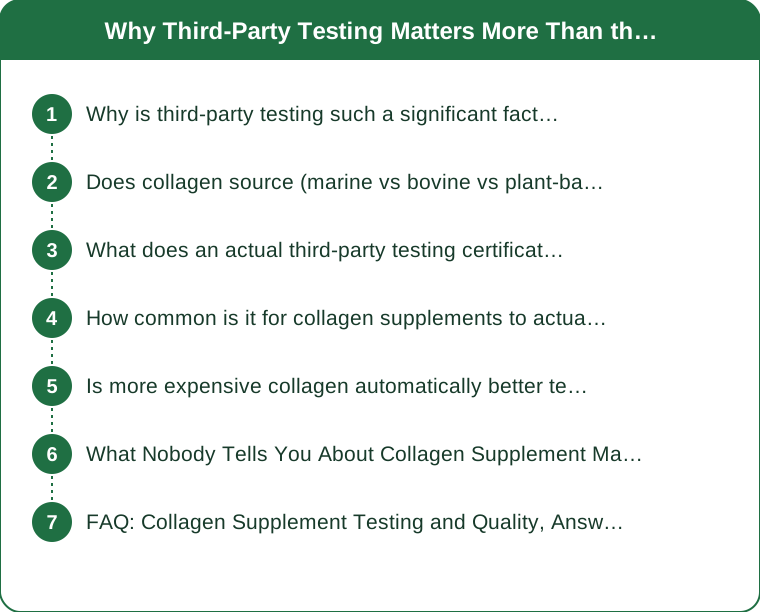
Why is third-party testing such a significant factor for supplements specifically?
Dietary supplements are regulated far less strictly than pharmaceuticals in most countries, including the United States, where the FDA does not require pre-market testing for supplement efficacy or exact label accuracy the way it does for drugs. This regulatory gap means the actual contents of a supplement can vary meaningfully from what’s printed on the label, and independent third-party testing is one of the only reliable checks against that gap. Organizations like NSF International, USP (United States Pharmacopeia), and Informed Sports provide independent verification that a product contains what it claims, in the stated amount, without unlisted contaminants like heavy metals — a real concern in some collagen products sourced from animal byproducts, since bioaccumulation of heavy metals can occur depending on the animal’s environment and diet.
Does collagen source (marine vs bovine vs plant-based) matter at all, then?
Source still matters, just for different reasons than third-party testing — it primarily affects amino acid composition, dietary restrictions (kosher, halal, pescatarian compatibility), and in some research, slightly different absorption profiles between marine and bovine collagen peptides. Marine collagen tends to have smaller peptide molecules, which some research suggests may absorb slightly more efficiently, though the clinical significance of this difference for actual skin or joint outcomes remains an active area of study rather than a settled fact. Plant-based ‘collagen boosters’ don’t contain actual collagen at all, since collagen is an animal protein, but instead provide amino acids and cofactors like vitamin C that support the body’s own collagen production — a meaningfully different mechanism worth understanding before assuming direct equivalence to animal-sourced collagen peptides.
What does an actual third-party testing certification look like on a label?
Look for a specific certifying body’s logo or explicit statement (NSF Certified for Sport, USP Verified, Informed Choice, or similar) rather than vague marketing language like ‘lab tested’ or ‘quality assured,’ which are unregulated marketing terms that don’t require any actual independent verification. A legitimate certification usually includes a certificate number or batch-specific verification that can often be looked up directly on the certifying organization’s website, which is worth doing if a brand’s certification claim seems vague or unverifiable at first glance.

How common is it for collagen supplements to actually fail these quality checks?
Independent testing organizations and academic research groups have periodically tested commercial collagen and general protein supplements and found a meaningful percentage failing to match labeled content within an acceptable margin, or containing detectable levels of heavy metals like lead or cadmium above recommended thresholds, particularly among lower-cost or less established brands without their own independent testing programs. This isn’t universal — many reputable brands test consistently and pass reliably — but it’s common enough that relying purely on label claims without any verification is a real, non-trivial risk rather than an overly cautious concern.
Is more expensive collagen automatically better tested or more reliable?
Not automatically — price correlates loosely with quality control investment but isn’t a reliable standalone indicator, since some premium-priced brands still lack independent testing while some moderately priced ones invest heavily in it. The presence of an actual verifiable third-party certification is a far more direct signal of quality assurance than price point alone, and checking for it takes only a minute or two on a testing organization’s website.
What Nobody Tells You About Collagen Supplement Marketing
Nobody tells you that the entire supplement industry’s marketing skews toward source story (grass-fed, wild-caught, sustainably sourced) precisely because it’s a more compelling, easier-to-photograph narrative than ‘this batch was independently verified for heavy metal content,’ even though the latter is arguably the more important quality signal for anyone actually trying to choose a safe, effective product. Source marketing isn’t dishonest, it’s just incomplete — and most consumers never think to look past it to the testing question at all.
FAQ: Collagen Supplement Testing and Quality, Answered
Is it possible to request testing information directly from a brand that doesn’t display certification prominently?
Yes, many reputable brands will provide a Certificate of Analysis (COA) for specific batches if asked directly through customer service, even if it’s not prominently displayed on the packaging itself.
Does third-party testing guarantee the product will actually work as claimed?
No — third-party testing verifies content accuracy and purity, not efficacy for a specific health outcome, which is a separate question involving the broader research on collagen supplementation itself.
Are there specific certifications more relevant to collagen specifically versus general supplements?
NSF and USP certifications apply broadly across supplement categories including collagen, while sport-specific certifications like NSF Certified for Sport add an additional layer of banned-substance testing that matters more for competitive athletes than general consumers.
TL;DR:
- Third-party testing verifies actual content accuracy and purity, which source marketing alone doesn’t address
- Collagen source affects amino acid profile and dietary compatibility, not necessarily safety or accuracy
- Look for specific certifying body names (NSF, USP) rather than vague ‘lab tested’ marketing language
- Independent testing has found real gaps between labeled and actual content in some commercial supplements
- Price doesn’t reliably predict whether a brand invests in independent testing
Sourcing makes for better marketing copy, but a verifiable third-party testing certification is the detail actually worth hunting for before trusting what’s on a collagen label.
Keep Reading
This article is for general informational purposes only and is not medical advice. Always consult a qualified health professional for guidance specific to you.