The Honest Buyer's Guide to Spotting a Low-Quality Collagen Supplement
Quick Answer: The clearest quality red flags in a collagen supplement are a missing or vague sourcing statement, no third-party testing certification, proprietary blends that hide actual dosage amounts, unusually low price relative to comparable products, and marketing claims that promise results faster than the collagen synthesis timeline actually allows — checking all five before buying avoids the majority of low-quality products on the market.
Collagen supplements occupy a strange space in the supplement industry: minimally regulated, heavily marketed, and genuinely variable in quality behind labels that often look nearly identical on a store shelf. A handful of specific checks separate the reliable products from the rest.

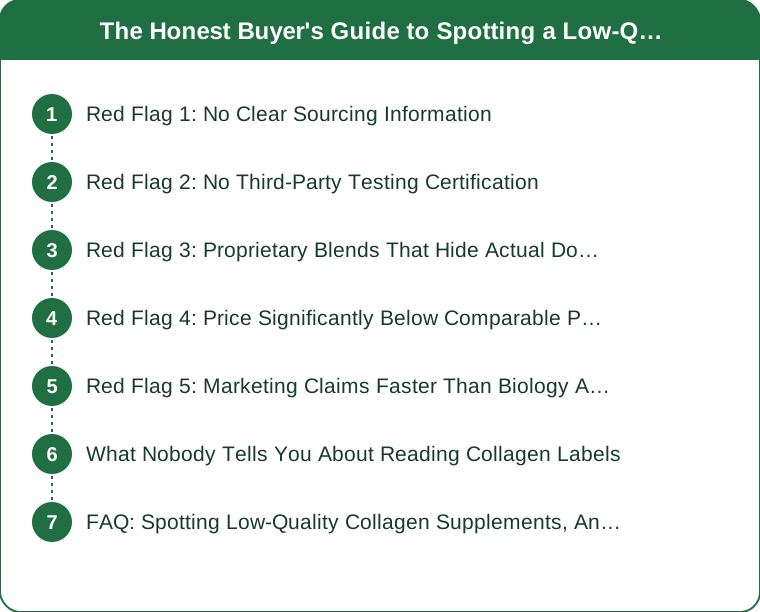
Red Flag 1: No Clear Sourcing Information
A quality collagen product should specify exactly what animal or source the collagen is derived from (bovine, marine, or specific fish species) and ideally where that source was raised or caught. Vague language like ‘premium collagen’ or ‘pure collagen protein’ without any sourcing detail is a meaningful red flag, since sourcing affects both amino acid profile and contamination risk, and reputable manufacturers are generally proud to specify it clearly rather than obscure it.
Marine collagen sourced from wild-caught fish, for instance, differs meaningfully in amino acid composition from bovine collagen sourced from grass-fed cattle, and a company confident in its sourcing quality will typically say so directly on the label rather than using vague marketing language that could apply to almost any source.
Red Flag 2: No Third-Party Testing Certification
Because supplements are less strictly regulated than pharmaceuticals in most markets, third-party testing certifications (such as NSF Certified for Sport, Informed Choice, or similar independent verification) provide meaningful assurance that a product actually contains what the label claims, and is free of certain contaminants like heavy metals. The absence of any third-party certification doesn’t automatically mean a product is bad, but its presence is one of the strongest positive signals available to a buyer without lab access of their own.
Heavy metal contamination is a documented concern in some lower-quality collagen products, particularly certain marine-sourced options, making third-party testing especially relevant for this supplement category compared to some others.
Red Flag 3: Proprietary Blends That Hide Actual Dosages
Some labels list a ‘proprietary collagen blend’ with a total weight but no breakdown of how much of that weight is actual collagen peptides versus fillers, flavoring agents, or other additives. This practice, common in lower-quality supplement categories generally, makes it impossible to know whether you’re getting a clinically relevant dose of collagen or a mostly-filler product with a small collagen component included for label purposes.
A transparent label lists the exact gram amount of hydrolyzed collagen peptides per serving, which is the actual number worth comparing across different brands and products rather than relying on the total serving size alone.

Red Flag 4: Price Significantly Below Comparable Products
Collagen peptide production, particularly hydrolysis (breaking collagen into smaller, more absorbable peptides), is a genuine manufacturing cost, and a product priced dramatically lower than comparable competitors for the same stated dosage often achieves that price through lower-quality sourcing, incomplete hydrolysis, or simply less collagen than claimed. This doesn’t mean the most expensive option is automatically the best, but an outlier-low price relative to the category is worth scrutinizing rather than treating as simply a good deal.
Red Flag 5: Marketing Claims Faster Than Biology Allows
Collagen synthesis and visible changes in skin or joint comfort typically take 8-12 weeks of consistent use to show measurable results in most research, so marketing claims promising dramatic visible changes within days or a couple of weeks are making promises the underlying biology doesn’t support. This kind of unrealistic timeline claim is a reasonable signal that a brand is prioritizing marketing over accurate expectation-setting, which often correlates with lower attention to actual product quality as well.
What Nobody Tells You About Reading Collagen Labels
The single most useful number on any collagen label is the grams of hydrolyzed collagen peptides per serving — comparing this number directly across brands, rather than comparing price or serving size alone, is the fastest way to identify whether a product is actually competitively dosed or just competitively priced through under-dosing.
FAQ: Spotting Low-Quality Collagen Supplements, Answered
Is more expensive always a sign of higher quality?
Not automatically, but an outlier-low price for a comparable dosage and sourcing claim is a stronger red flag than a higher price is a green flag on its own.
Does the type of collagen (bovine vs. marine) indicate quality on its own?
No — both can be high or low quality depending on sourcing and processing; the type itself is a preference and formulation choice, not a quality indicator by itself.
How long should I try a collagen supplement before judging whether it’s working?
Give it a realistic 8-12 weeks of consistent daily use before evaluating results, since this matches the general timeline for measurable collagen synthesis changes.
TL;DR:
- Vague or missing sourcing information is one of the clearest quality red flags
- Third-party testing certification offers real assurance in a loosely regulated category
- Proprietary blends hide actual collagen dosage — look for the specific gram amount instead
- Marketing claims promising results faster than 8-12 weeks overstate what biology actually allows
Before your next purchase, check the label against all five red flags — it takes a few minutes and rules out most of the lower-quality options on the shelf.
Keep Reading
This article is for general informational purposes only and is not medical advice. Always consult a qualified health professional for guidance specific to you.