The Complete Guide to Choosing a Collagen Supplement That Actually Works for You
Quick Answer: Choosing a collagen supplement that actually works for your goals comes down to four factors — collagen type (I, II, or III depending on target), source (bovine, marine, or vegan-friendly boosters), dose (typically 2.5-15g depending on studied use), and third-party testing — and most of the confusing marketing on collagen packaging boils down to these four variables presented differently.
The collagen aisle is genuinely overwhelming — different types, sources, doses, and formats all claiming similar benefits. Once you understand what each variable actually does, choosing the right one for your specific goal gets much simpler.

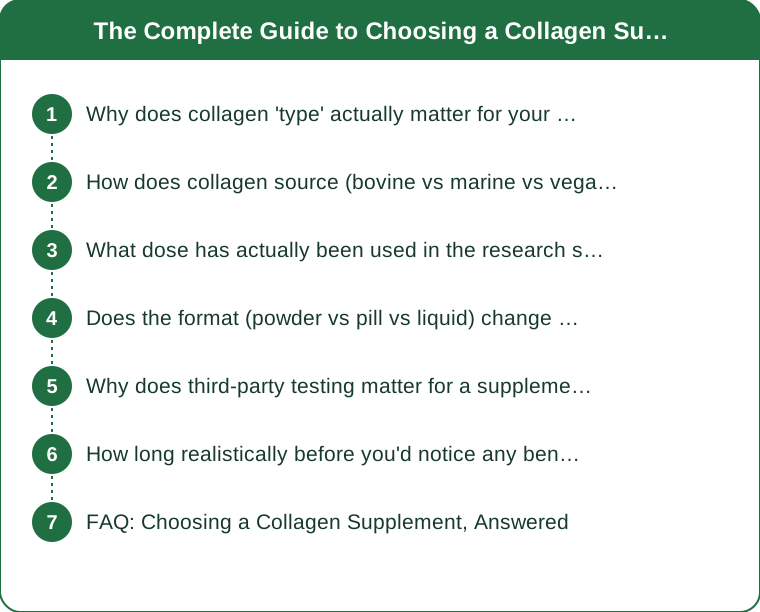
Why does collagen ‘type’ actually matter for your specific goal?
Type I collagen is the most abundant in skin, hair, nails, and bone, and is most associated with anti-aging and beauty-focused benefits. Type II is concentrated in cartilage and is the type most studied for joint health specifically. Type III often appears alongside Type I and supports skin elasticity. Most general-purpose skin and joint supplements use Type I, sometimes blended with III, while dedicated joint products often isolate Type II — matching the type to your actual goal is more useful than picking based on price or brand alone.
How does collagen source (bovine vs marine vs vegan) actually differ?
Bovine collagen (from cattle) is generally Type I and III and tends to be the most affordable, widely studied option. Marine collagen (from fish) is also predominantly Type I, often marketed as more bioavailable, though evidence for a meaningfully faster absorption rate over bovine is mixed rather than conclusively settled. True vegan collagen doesn’t exist as an animal protein — vegan products instead provide collagen-building nutrients (vitamin C, proline, glycine precursors) to support your body’s own production rather than delivering collagen protein directly, which is a meaningfully different mechanism worth understanding before buying.
What dose has actually been used in the research showing benefits?
Studies showing measurable skin or joint benefits have generally used doses in the 2.5-15g per day range, with skin-focused studies often in the lower-to-mid part of that range and joint-focused studies sometimes at the higher end. Checking that a product’s actual per-serving dose falls within a range studies have used is more useful than assuming any collagen product, regardless of amount, delivers the same benefit.

Does the format (powder vs pill vs liquid) change effectiveness?
Not fundamentally — collagen is broken down into peptides during digestion regardless of format, so the meaningful differences between powder, pill, and liquid products come down to convenience, dose per serving, and added ingredients, rather than one format being inherently more effective at delivering collagen than another.
Why does third-party testing matter for a supplement like this?
Collagen supplements, like most dietary supplements in the US, aren’t rigorously pre-market tested by the FDA the way medications are. Third-party testing certifications (from independent testing organizations) provide a meaningful layer of verification for purity and label accuracy that isn’t otherwise guaranteed, and are worth specifically looking for on packaging or a brand’s website.
How long realistically before you’d notice any benefit from a chosen supplement?
As with most collagen-related benefits, allow at least 8-12 weeks of consistent daily use before judging whether a specific product and dose are working for you — this aligns with skin and joint tissue’s natural turnover timeline, and shorter trial periods are unlikely to give an accurate read regardless of which product you’ve chosen.
FAQ: Choosing a Collagen Supplement, Answered
Is a more expensive collagen supplement automatically better?
Not necessarily — price often reflects source (marine tends to cost more than bovine) and marketing rather than a proven superior outcome; checking type, dose, and testing certification matters more than price alone.
Can you combine collagen types or sources?
Yes, some products blend types (I and III together, for example) intentionally to support multiple goals simultaneously, and there’s no established harm in combining different collagen sources.
Is food-based collagen (bone broth, etc.) a reasonable alternative to supplements?
Yes, whole-food sources provide collagen and collagen-building nutrients too, though controlling exact dose is harder than with a measured supplement, which matters if you’re trying to match a specific studied amount.
TL;DR:
- Match collagen type to your specific goal — Type I/III for skin, Type II for joints
- Bovine and marine sources are both Type I/III with similar general effectiveness
- Look for a dose within the 2.5-15g studied range and third-party testing certification
- Format (powder, pill, liquid) matters less than type, dose, and testing
- Give any chosen product 8-12 weeks before judging whether it’s working
This is general information, not medical advice — individual results and needs vary, especially for anyone with an existing medical condition.
Keep Reading
This article is for general informational purposes only and is not medical advice. Always consult a qualified health professional for guidance specific to you.