Eating for Collagen: The Food-First Guide to Skin's Favorite Protein
Quick Answer: Your body builds collagen from amino acids in any complete protein — you don’t need to eat collagen to make it. What you do need is adequate daily protein (roughly 1.2–1.6 g per kg of bodyweight), plus vitamin C, which collagen synthesis literally cannot proceed without. Bone broth, fish skin, eggs, dairy, and legumes supply the materials; citrus, peppers, and berries supply the cofactor.
There’s a $40 tub of collagen powder in your cupboard and a lingering suspicion that you’ve been had.
Partly right, partly wrong. And the interesting part is what your body is doing in the meantime.
Before collagen was a powder, it was a production line — one your body runs daily, from raw materials that arrive on your plate.

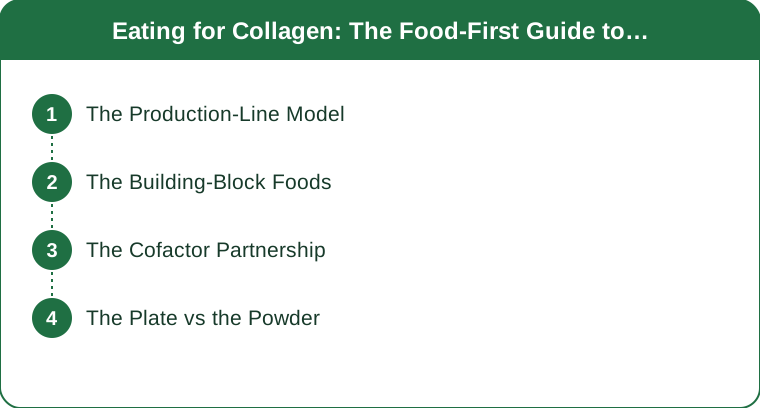
How Does Your Body Actually Make Collagen?
It assembles it from amino acids — primarily glycine, proline, and hydroxyproline — supplied by the protein you eat.
Here’s the part that reframes the whole supplement conversation: the collagen you swallow doesn’t arrive in your skin as collagen. Your digestive system breaks it down into amino acids and small peptides, exactly as it does with chicken, eggs, or lentils. Those building blocks then go into a general pool your body draws from.
So a collagen supplement is, mechanically, a rather expensive protein powder with a specific amino acid profile.
The one genuinely interesting caveat: some research suggests certain collagen-derived peptides may survive digestion intact and act as a signal — essentially telling fibroblast cells to increase collagen production. The evidence is early and the effect sizes are modest, but it’s the one plausible argument for the powder beyond its amino acids.
The demand side matters too. Collagen production declines with age and is degraded by UV exposure and smoking. Materials help when you’re short of them. They don’t help when the problem is damage — which is why sunscreen and retinoids remain the headline acts in skin, and food is the supporting cast.
Which Foods Supply Collagen’s Building Blocks?
Four tiers, roughly by directness:
1. The glycine-rich tier. Bone broth is the famous one and its case is legitimate — it’s genuinely high in glycine and proline. Also: chicken skin, pork shoulder, oxtail, and the collagen-dense cuts. Traditional nose-to-tail eating patterns were accidental collagen protocols long before anyone marketed one.
2. Complete protein, the actual baseline. Eggs, dairy, fish, meat, poultry, soy. Your daily protein target is your collagen budget, and this is where most people’s real gap lives. Someone eating 45 g of protein a day has a genuine materials shortage that no $40 tub meaningfully solves.
Target: roughly 1.2–1.6 g per kg of bodyweight for most adults, higher if you train.
3. The fish skin note. Crisped salmon skin is a collagen-and-omega-3 delivery vehicle that fillet-only eaters throw away. Sardines with bones in are similar.
4. Plants — the honest version. Plants contain no collagen (it’s an animal structural protein), but they supply the amino acids required to synthesize it. Vegetarian and vegan collagen production runs perfectly well on adequate total protein — legumes, tofu, tempeh, seitan, quinoa — plus the cofactors below. Soy and legumes are notably high in glycine.

Why Is Vitamin C Essential for Collagen?
Because the enzymes that build collagen physically cannot function without it.
This isn’t a wellness-marketing claim. Vitamin C is a required cofactor for the hydroxylation of proline and lysine — the step that lets collagen strands form their stable triple helix. Without it, the strands never stabilize.
Scurvy is collagen failure. Bleeding gums, poor wound healing, and skin that breaks down are all what happens when collagen synthesis stops for lack of vitamin C. That’s how load-bearing this one nutrient is.
You don’t need much — 75–90 mg daily covers it, which is one orange or half a bell pepper. But you do need it consistently, since vitamin C isn’t stored.
The practical habit: pair vitamin C with your protein meals. Peppers with eggs, berries with Greek yogurt, a squeeze of lemon over fish, tomatoes with anything.
Supporting cast: zinc and copper both play roles in collagen formation and cross-linking. Nuts, seeds, shellfish, and legumes cover both. It’s the varied-diet answer again, unglamorously.
Myth vs Fact: Collagen and Diet
Myth: Eating collagen puts collagen in your skin. Fact: It’s digested into amino acids first, same as any protein. There is no direct pipeline from a tub to your face.
Myth: Bone broth is a uniquely powerful collagen source. Fact: It’s genuinely high in glycine and proline, and it’s also mostly water. A cup of bone broth typically supplies 6–10 g of protein — less than two eggs. Good food, oversold.
Myth: Vegans can’t produce collagen well. Fact: They produce it fine given adequate total protein and vitamin C. Plants don’t contain collagen; they contain everything needed to build it.
Myth: More protein means more collagen. Fact: Only up to the point where you’re no longer deficient. Beyond adequate intake, extra protein doesn’t drive extra collagen — the limiting factor becomes cellular signaling and damage, not materials.
Myth: Diet is the main lever for skin collagen. Fact: Sun exposure is. Chronic UV damage degrades existing collagen and impairs new synthesis, and it outweighs every dietary factor combined. This is the one people least want to hear.
Does the Plate Beat the Powder?
For most people, yes — with one honest exception.
Where food wins: a protein-anchored day with vitamin C-rich produce supplies everything the powder does, plus fiber, satiety, micronutrients, and the whole-food package. At grocery prices. Breadth is not close.
Where the powder has a real case: if you’re genuinely struggling to hit a protein target — poor appetite, illness recovery, older adults with reduced intake — a scoop is a convenient 10–20 g. That’s a legitimate use, and it’s a protein-gap argument rather than a collagen-magic one.
The timeline is identical either way. Skin remodeling happens over months, not weeks. Food or powder, expect 8–12 weeks before any change is fair to assess, and don’t expect dramatic results from either.
The stack that actually works:
- Protection — daily SPF. The single biggest lever, by a distance.
- Signal — a retinoid, which does have solid evidence for stimulating collagen production.
- Materials — adequate protein and vitamin C from food.
- Repair — sleep, which is when most of it happens.
And the anti-demand side: excess sugar drives glycation, which stiffens existing collagen fibers, while smoking actively degrades them. Those two out-damage anything the supplement aisle can repair. The skip-list matters more than the shopping list.
Frequently Asked Questions
Do collagen supplements actually work?
Some trials show modest improvements in skin hydration and elasticity with hydrolyzed collagen peptides, typically at 2.5–10 g daily over 8–12 weeks. Effect sizes are small and several studies are industry-funded. It’s not useless, but it’s a minor lever compared to sun protection and retinoids.
How much protein do you need for collagen production?
Roughly 1.2–1.6 g per kg of bodyweight daily for most adults, which is above the minimum RDA. Anyone consistently under that has a genuine materials shortage. Spreading protein across meals rather than loading it into dinner appears to support synthesis better.
Can you get collagen from plant-based foods?
You can’t get collagen itself — it only exists in animal tissue — but you can get every amino acid needed to build it. Soy, legumes, tofu, tempeh, seitan, and quinoa are all good sources of glycine and proline. Combined with adequate vitamin C, plant-based collagen synthesis works normally.
Does bone broth really help your skin?
It supplies glycine and proline, so it contributes materials. But a cup contains only 6–10 g of protein, so it’s a small contributor to your daily total rather than a special intervention. It’s a pleasant, mineral-rich food — just not a shortcut.
When to Check With a Professional
Persistent poor wound healing, easy bruising, or bleeding gums can indicate a vitamin C deficiency or another nutritional issue and warrant a doctor’s assessment rather than self-treatment. Sudden or significant changes in skin texture, elasticity, or pigmentation should also be looked at, since a small number of connective tissue and endocrine conditions present that way.
Talk to a doctor or registered dietitian before starting supplements if you’re pregnant, breastfeeding, managing kidney disease (protein intake needs individual guidance there), or taking medications — collagen supplements are generally low-risk but high protein intake is not appropriate for everyone.
This article is for general information and isn’t medical or nutritional advice.
TL;DR:
- Your body builds collagen from amino acids in any complete protein — eating collagen isn’t required, adequate protein is.
- Target roughly 1.2–1.6 g protein per kg bodyweight. That’s your actual collagen budget.
- Vitamin C is non-negotiable: synthesis literally can’t proceed without it. Pair produce with protein meals.
- Bone broth and fish skin are good sources, plants supply the building blocks fine. Plants just don’t contain collagen itself.
- Sunscreen and a retinoid outrank every dietary factor. Sugar and smoking do more damage than any powder repairs.
Keep Reading
This article is for general informational purposes only and is not medical advice. Always consult a qualified health professional for guidance specific to you.