Collagen Powder vs. Regular Protein Powder: Which Should You Actually Use?
Quick Answer: Collagen powder is an incomplete protein best suited for skin, joint, and connective tissue support, while whey or plant protein powders are complete proteins better suited for muscle building and general protein needs — they serve different goals and aren’t direct substitutes for each other.
You see both sitting in the same supplement aisle and assume they’re interchangeable protein options. They’re built from different amino acid profiles serving genuinely different purposes.

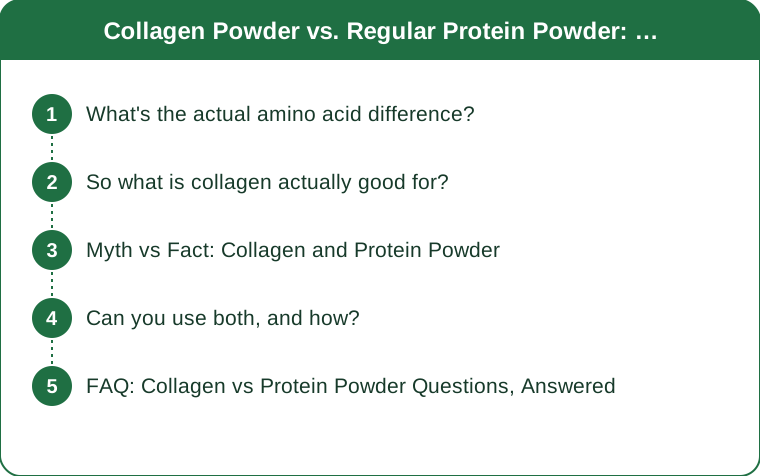
What’s the actual amino acid difference?
Collagen is an incomplete protein — it’s missing or very low in certain essential amino acids, notably tryptophan, that your body needs from food since it can’t produce them itself.
Whey and most plant protein blends are complete proteins, containing all essential amino acids in reasonable amounts — this is why they’re the better choice specifically for muscle protein synthesis and general daily protein targets.
So what is collagen actually good for?
Collagen is rich in glycine, proline, and hydroxyproline — amino acids that are structurally important for skin, joints, tendons, and connective tissue specifically, which is the basis for its popularity in skin-and-joint-focused supplementation.
It’s not the wrong choice — it’s simply targeting a different outcome (connective tissue support) than muscle-building protein sources are designed for.

Myth vs Fact: Collagen and Protein Powder
Myth: Collagen powder can replace your regular protein intake. Fact: Because it’s missing key essential amino acids, relying on collagen as your primary protein source can leave gaps that a complete protein source fills more reliably.
Myth: Collagen powder builds muscle the same way whey does. Fact: Research on collagen’s role in muscle protein synthesis is far less robust than for complete proteins like whey — it’s not positioned or well-supported as a muscle-building protein.
Myth: If a product has ‘protein’ on the label, it serves the same purpose regardless of source. Fact: Total grams of protein matters less than amino acid completeness for goals like muscle building — a gram of whey and a gram of collagen aren’t functionally interchangeable for that specific purpose.
Can you use both, and how?
Yes — many people use them for different goals in the same day: whey or plant protein post-workout or as a general protein source, collagen added to coffee or a smoothie separately for its skin/joint-focused amino acids.
There’s no meaningful downside to using both, as long as you’re not substituting collagen for your primary protein source when muscle building or general protein adequacy is the actual goal.
FAQ: Collagen vs Protein Powder Questions, Answered
Does collagen count toward my daily protein target?
It contributes grams of protein, but because it’s incomplete, it shouldn’t be your primary source if hitting a complete-protein target for muscle building is the goal.
Is plant protein a complete protein like whey?
Many single plant sources aren’t complete alone, but blended plant protein powders (pea plus rice, for example) are formulated to be complete, similar to whey.
Should athletes prioritize whey over collagen?
For muscle-building and recovery goals specifically, yes — whey or another complete protein source is better supported for that purpose than collagen.
TL;DR:
- Collagen is an incomplete protein; whey and blended plant proteins are complete proteins
- Collagen targets skin, joint, and connective tissue support specifically
- Complete proteins are better supported for muscle building and general protein needs
- Using both for their different purposes is fine — just don’t substitute one for the other’s job
They’re complementary tools with different jobs, not competing versions of the same product.
Keep Reading
This article is for general informational purposes only and is not medical advice. Always consult a qualified health professional for guidance specific to you.