Collagen Loss After 30: The Complete Guide to What's Actually Happening in Your Skin (and What Genuinely Helps)
Quick Answer: Collagen production declines by roughly 1% per year starting in your mid-20s to 30s, accelerating further after menopause — but daily SPF, topical retinoids, and select lifestyle changes have real evidence behind slowing that decline, while oral collagen supplements have more modest, less consistent support.
The number ‘1% per year’ gets repeated everywhere in skincare marketing, but almost nobody explains where it comes from, what it actually means for your skin day to day, or which of the dozen things marketed to fix it are worth your money. This is the longer, more honest version, covering the biology, the data, and the honest ranking of what actually helps versus what’s mostly noise.

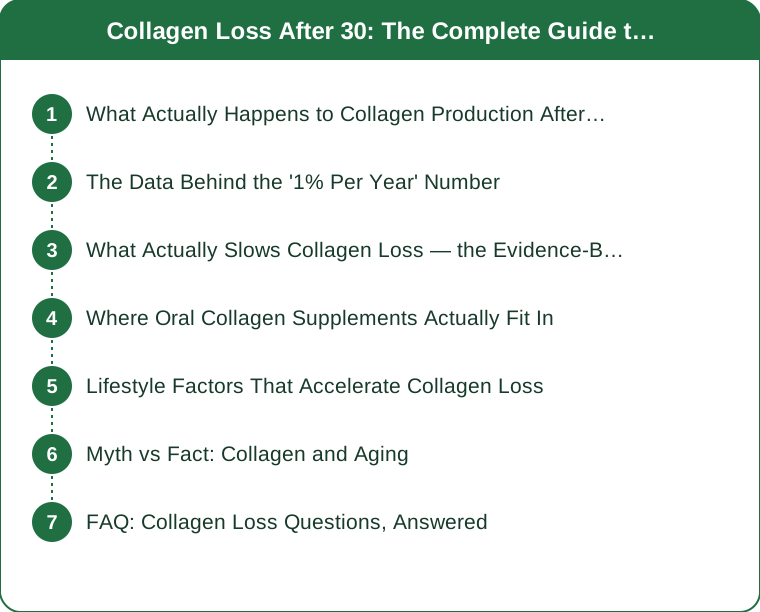
What Actually Happens to Collagen Production After 30
Collagen is the structural protein that gives skin its firmness and elasticity, produced by cells called fibroblasts in the dermis, the layer of skin beneath the visible surface. Fibroblast activity — both how much collagen they produce and how efficiently they replace collagen that naturally breaks down through a constant, ongoing turnover process — declines gradually starting in the mid-to-late 20s. This isn’t a switch that flips at exactly 30; it’s a gradual curve that becomes more noticeable in your 30s simply because enough cumulative decline has occurred to become visible as fine lines, reduced bounce, and slower wound healing.
The decline also isn’t linear across a lifetime — it accelerates further during and after menopause, when estrogen decline directly affects collagen synthesis, with some research estimating a much steeper drop in the first five years post-menopause than in the entire decade before it. This means the ‘1% per year’ figure is really an average across a curve that’s flatter in your late 20s and early 30s and considerably steeper later on, particularly around the menopausal transition.
The Data Behind the ‘1% Per Year’ Number
The commonly cited figure — roughly 1% of collagen lost per year starting around age 20-25 — traces back to older dermatology research measuring skin collagen content across age groups, and it holds up reasonably well as a rough average, though individual variation is significant based on genetics, sun exposure history, and hormonal factors. By that math, someone in their mid-30s has already lost somewhere around 10-15% of the collagen density they had in their early twenties, which is a meaningful enough change to show up as visible texture and firmness differences, even without dramatic wrinkling yet.
It’s worth noting this figure describes an average population trend, not a fixed individual trajectory — someone with significant lifetime sun protection and no smoking history will typically track meaningfully better than this average, while someone with heavy unprotected sun exposure can track considerably worse, which is part of why two people the same age can look noticeably different in skin firmness and texture.
What Actually Slows Collagen Loss — the Evidence-Backed List
Daily broad-spectrum SPF has the strongest evidence of any single intervention, because UV exposure is the single largest external driver of collagen breakdown (a process called photoaging) — daily sunscreen use has been shown in longitudinal studies to measurably slow visible skin aging compared to inconsistent use, with one well-known Australian study finding meaningfully less visible skin aging over 4 years in the daily-SPF group compared to the discretionary-use group.
Topical retinoids (prescription tretinoin or over-the-counter retinol) have decades of clinical trial data showing they stimulate new collagen production and improve fine lines and texture — this is one of the most well-studied anti-aging interventions in dermatology, not a fad, with mechanisms well understood at the cellular level: retinoids upregulate fibroblast activity and also help normalize how skin cells shed and turn over.
Vitamin C serums support collagen synthesis as a cofactor in the production process itself — collagen synthesis literally cannot proceed properly without adequate vitamin C at the cellular level — and add antioxidant protection against UV-driven breakdown, with reasonable clinical support for topical use, particularly in combination with SPF rather than as a replacement for it.

Where Oral Collagen Supplements Actually Fit In
Oral collagen peptide supplements have a smaller but genuinely growing body of clinical trial support, with several placebo-controlled studies showing modest improvements in skin elasticity and hydration after 8-12 weeks of consistent daily use. The effect sizes in these studies are real but modest — meaningfully smaller than what daily SPF or a retinoid delivers, and the supplement doesn’t get incorporated as intact collagen (it’s broken down to amino acids like any other dietary protein and then may support collagen synthesis indirectly, alongside plenty of other proteins your body already gets from food).
Most of the positive trials use doses in the range of 2.5 to 10 grams of hydrolyzed collagen peptides daily, and the studies showing benefit tend to run at least 8 weeks before measuring outcomes — shorter trials or lower doses are less consistently linked to visible change, which is worth knowing before judging whether a specific product ‘worked’ after only a couple of weeks of use.
The honest takeaway: worth considering as one additional piece for someone who already has SPF and a retinoid in their routine, not a replacement for either, which have stronger and more direct evidence. Marketing that positions collagen powder as a standalone solution is overstating what the current research actually supports, even though the supplement category isn’t without any merit at all.
Lifestyle Factors That Accelerate Collagen Loss
Sun exposure is the largest accelerant by far — UV radiation directly breaks down existing collagen through enzymes called matrix metalloproteinases that UV exposure activates, and it also damages the fibroblasts that produce new collagen, which is why the difference between sun-protected and sun-exposed skin on the same person (compare an inner arm to a face, or a long-haul truck driver’s more sun-exposed driving-side arm to their other arm, a comparison that’s been documented in dermatology literature) can look like a decade or more of age difference.
Smoking measurably accelerates collagen breakdown through multiple mechanisms, including reduced blood flow to skin from nicotine’s vasoconstricting effect and direct enzymatic damage to existing collagen fibers from compounds in cigarette smoke.
Chronic high sugar intake contributes to a process called glycation, where sugar molecules bind to collagen fibers and make them stiffer and more brittle over time — a real, if slower-acting, contributor separate from sun damage, sometimes called the ‘sugar sag’ effect in dermatology discussions of diet and skin aging.
Poor sleep disrupts the overnight window when skin does much of its repair and collagen synthesis work, making chronic sleep deprivation a genuine, if less discussed, accelerant — skin repair processes are measurably more active during deep sleep stages than during waking hours.
Myth vs Fact: Collagen and Aging
Myth: once collagen is lost, nothing brings it back. Fact: fibroblasts continue producing new collagen throughout life — the issue is the rate of production versus breakdown shifting unfavorably with age, not a total production shutoff, which is exactly why interventions that stimulate fibroblast activity (retinoids, certain lasers, microneedling) can still meaningfully improve skin over time at any age, even in someone in their 60s or 70s.
Myth: collagen supplements are basically snake oil with zero evidence. Fact: this oversells the counter-argument — there’s real, if modest, clinical trial support for oral collagen peptides improving hydration and elasticity; the fair criticism is that the effect size is smaller than more established interventions, not that there’s no effect at all.
Myth: expensive skincare products always deliver more collagen benefit than cheaper ones. Fact: the active ingredient and its concentration matter far more than price point — a well-formulated drugstore retinol at an appropriate concentration can outperform an expensive product with a poorly dosed or unstable version of the same active ingredient.
What about in-office procedures like microneedling or lasers?
Beyond at-home products, several in-office procedures have clinical evidence for stimulating collagen production through a shared mechanism: controlled micro-injury to the skin triggers a genuine wound-healing response, and part of that response involves new collagen synthesis. Microneedling creates thousands of tiny controlled punctures using fine needles, prompting new collagen over the following weeks, with results typically building gradually over a series of sessions rather than after just one treatment. Fractional lasers work on a similar wound-response principle using targeted heat instead of physical punctures. Both carry more cost, downtime, and side-effect risk than daily SPF and a retinoid, which is why dermatologists generally frame them as an addition once the foundational daily habits are already solidly in place, not a shortcut that replaces them. Choosing a licensed, experienced provider matters more for these procedures than for almost anything else in skincare, since the risk profile (scarring, pigment changes) scales directly with technique and equipment settings, not just the treatment type itself.
FAQ: Collagen Loss Questions, Answered
At what age should I start actively worrying about collagen loss?
There’s no need to ‘worry,’ but starting daily SPF and a gentle retinoid in your late 20s to early 30s — before visible decline accumulates — is broadly considered more effective than starting reactively once changes are already visible, since it’s easier to preserve existing collagen density than to rebuild lost density later.
Do collagen-rich foods like bone broth actually help?
They provide amino acids that are building blocks for collagen synthesis generally, but there’s no strong evidence they’re preferentially routed into skin collagen specifically over any other protein in your diet — think of them as a reasonable part of adequate protein intake, not a targeted skin treatment with a specific dose-response relationship the way a topical retinoid has.
Is it too late to start protecting collagen if I’m already in my 40s or 50s?
No — SPF and retinoids continue to show measurable benefit for skin texture and firmness when started at any age, since they work by supporting ongoing fibroblast activity, which continues throughout life regardless of when you start protecting it, even though the starting baseline will naturally differ from someone who started in their 20s.
How do I know if my skincare routine is actually working versus just marketing placebo?
Realistic timelines matter here — retinoids typically show visible texture improvement over 8-12 weeks of consistent use, and expecting dramatic change within days is a setup for disappointment regardless of how good the product actually is; tracking with consistent, similarly-lit photos monthly is more reliable than day-to-day mirror checks.
Does diet in general matter for collagen, beyond just collagen-specific supplements?
Overall adequate protein intake, along with nutrients that support collagen synthesis directly — vitamin C, zinc, and copper — matter more than any single ‘collagen food,’ since the body needs the full set of raw materials and cofactors to actually build new collagen, not just one input in isolation.
Can stress actually accelerate visible skin aging through a collagen-related pathway?
Chronic stress raises cortisol, and sustained elevated cortisol has been linked in research to reduced collagen synthesis and slower skin repair, which gives the common observation that stressful periods seem to show up on the skin a genuine biological basis rather than being purely anecdotal.
Does exercise have any measurable effect on collagen levels?
Regular moderate exercise is associated with better skin blood flow and lower baseline inflammation, both of which create a more favorable environment for fibroblast function, though the effect is indirect and considerably smaller than the direct impact of daily sun protection.
TL;DR:
- Collagen production declines roughly 1% per year starting in your mid-20s to 30s, accelerating further post-menopause
- Daily SPF and topical retinoids have the strongest evidence of any interventions available
- Oral collagen supplements show real but modest benefit — a supplement to the basics, not a replacement
- Sun exposure, smoking, high sugar intake, and poor sleep all measurably accelerate the decline
- It’s never too late to start — fibroblasts keep producing collagen at any age, they just need the support
The unsatisfying but honest truth is that the two cheapest, most boring interventions — sunscreen and a retinoid — outperform almost everything marketed as a breakthrough. Everything else is a reasonable addition on top of that foundation, not a substitute for it.
Keep Reading
This article is for general informational purposes only and is not medical advice. Always consult a qualified health professional for guidance specific to you.