Can Collagen Actually Help You Recover Faster From Workouts?
Quick Answer: Collagen supports connective tissue (tendons, ligaments, joint cartilage) recovery more than muscle tissue itself — it’s not a replacement for protein, but it fills a specific gap most protein powders don’t cover.
If you’ve started taking collagen for your skin and wondered whether it’s doing anything for your workouts, you’re asking the right question — most marketing skips right past it.

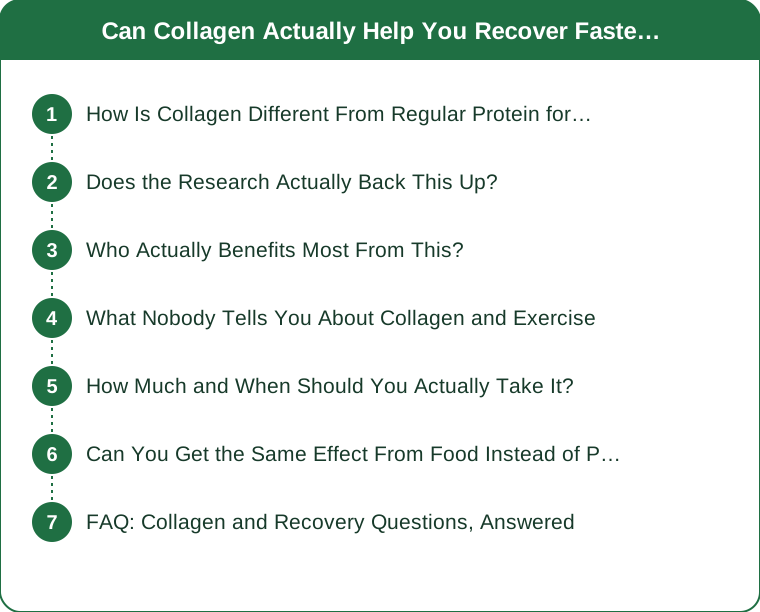
How Is Collagen Different From Regular Protein for Recovery?
Whey and other complete proteins are what actually rebuild muscle fiber — they’re rich in the branched-chain amino acids (especially leucine) that trigger muscle protein synthesis. Collagen is missing enough of those to do that job well on its own.
What collagen has instead is a high concentration of glycine and proline, the amino acids that make up tendons, ligaments, and the cartilage lining your joints. Those tissues have far slower blood flow than muscle, so they recover more slowly and benefit from a different amino acid supply.
Does the Research Actually Back This Up?
Yes, with a specific catch: timing matters. A 2017 study in the American Journal of Clinical Nutrition found that taking 15g of collagen about 60 minutes before exercise increased collagen synthesis markers significantly more than taking it at a random time of day. Vitamin C taken alongside it appears to help the body actually use it for collagen production.
This lines up with athletes and dancers who’ve used gelatin/collagen protocols for tendon and ligament resilience for years, often without knowing the mechanism.
Who Actually Benefits Most From This?
If your training involves a lot of joint loading — running, jump training, heavy lifting, anything with repetitive tendon stress — collagen timed before your session is more relevant to you than someone doing mostly low-impact cardio.
People recovering from a tendon or ligament injury, or managing early joint stiffness, tend to report the most noticeable difference. If your limiting factor is muscle soreness specifically, whey protein will do more for you.

What Nobody Tells You About Collagen and Exercise
Collagen supplements won’t build muscle, and taking it doesn’t mean you can skip your regular protein target. Most people who feel a difference are actually addressing a joint-health gap they didn’t know they had, not a muscle-recovery one.
Also worth knowing: the collagen you eat gets broken down into individual amino acids in digestion — your body doesn’t just ship intact collagen straight to your knees. It uses those amino acids as raw material, and where it prioritizes them depends on what tissue needs repair most at that moment.
How Much and When Should You Actually Take It?
The dose used in most of the supporting research is 15-20g, taken about an hour before training, ideally with a source of vitamin C (a small glass of orange juice works). Taking it at a completely different time of day, like with breakfast, appears to blunt the connective-tissue-specific benefit.
Consistency matters more than any single dose — the research showing joint benefits generally used protocols lasting 3-6 months, not a few weeks.
Can You Get the Same Effect From Food Instead of Powder?
Bone broth and slow-cooked cuts with connective tissue (oxtail, short rib, chicken feet) contain natural gelatin, which is cooked collagen and behaves similarly in the body. The amino acid profile is comparable, though the concentration per serving is usually lower and harder to standardize than a measured powder scoop.
If you already eat these regularly, you may be getting a meaningful amount without supplementing — but most people don’t eat them often enough to match a daily 15g dose.
FAQ: Collagen and Recovery Questions, Answered
Should I take collagen instead of my regular protein shake?
No — treat it as an addition for connective tissue, not a swap. Your muscle-building protein target stays the same.
Does the type of collagen (bovine vs marine) matter for this?
Both work similarly for connective tissue; marine collagen has a slightly different amino acid ratio but the practical difference for recovery is small. Pick whichever you tolerate and will actually take consistently.
How long before I’d notice anything?
Most studied benefits (tendon stiffness, reported joint comfort) showed up after 8-12 weeks of daily use, not days. This is general information, not medical advice — talk to a doctor about persistent joint pain.
TL;DR:
- Collagen supports tendons, ligaments, and cartilage more than it supports muscle rebuilding
- Taking 15-20g about an hour before training, with vitamin C, matches the research protocols that showed benefit
- It’s an addition to your protein routine, not a replacement
- Give it 8-12 weeks before judging whether it’s working
If your joints are the thing slowing you down, this is worth trying — if it’s sore muscles, your protein shake is still doing the heavier lifting.
Keep Reading
This article is for general informational purposes only and is not medical advice. Always consult a qualified health professional for guidance specific to you.