Collagen and Menopause: The Accelerated Loss Nobody Warns You About
Quick Answer: Skin collagen falls by roughly 30 percent in the first five years after menopause, then around 2 percent per year after that — a far steeper curve than the gradual decline of your thirties and forties. The driver is estrogen loss, not aging alone. Resistance training, adequate protein, sun protection, and topical retinoids have the strongest evidence; supplements are a modest add-on.
The change does not feel gradual. A lot of women describe skin, joints, and hair shifting noticeably within a year or two, and wonder what suddenly went wrong.
Nothing went wrong. A specific and well-documented thing happened, it has a timeline, and quite a lot of it is modifiable.

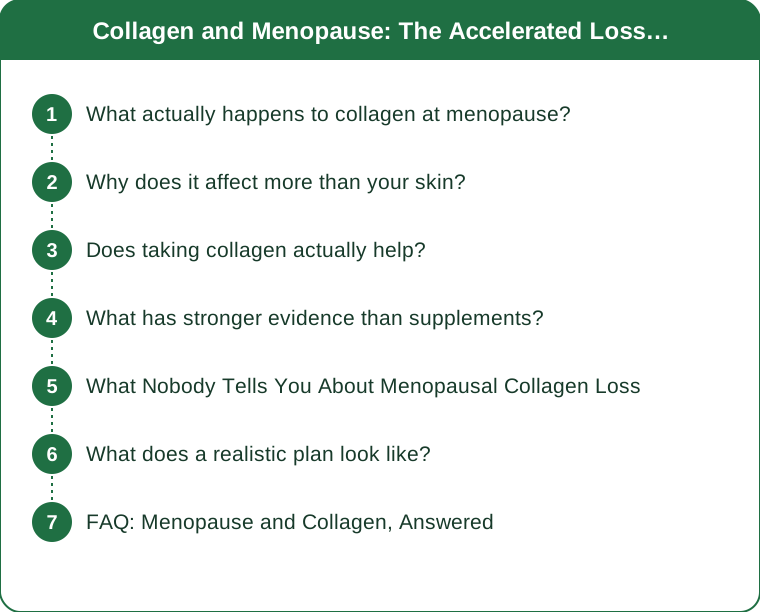
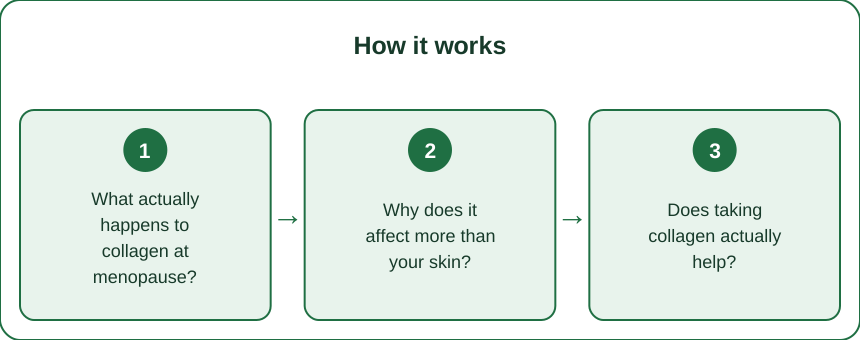
What actually happens to collagen at menopause?
Estrogen is directly involved in collagen production. Skin fibroblasts — the cells that manufacture collagen — carry estrogen receptors, and estrogen signaling supports both how much collagen they produce and how much water the skin holds through hyaluronic acid.
When estrogen falls, that signaling drops with it. The consequence is well documented: research consistently reports that women lose around 30 percent of skin collagen in the first five years post-menopause, followed by a slower decline of roughly 2 percent per year over the next two decades.
Compare that to the background rate — commonly cited at around 1 percent per year from your mid-twenties — and the shape of the curve becomes clear. This is not a gentle continuation of what was already happening. It is a compressed period of much faster loss, concentrated into a few years.
Which also explains the timing confusion. Women often report that their skin changed “overnight in my early fifties,” and that perception is closer to accurate than the standard aging narrative suggests. The change genuinely is faster during this window.
It is worth naming the practical implication: the years right around menopause are the highest-leverage window for intervention, because that is when the steepest part of the curve is happening. Effort during this period does more than the same effort a decade later.
Why does it affect more than your skin?
Collagen is the most abundant protein in the body, and skin is only one place it does structural work. The same decline shows up in tissues people rarely connect to it.
Joints and tendons. Cartilage and tendon are collagen-rich, and many women notice new stiffness, more frequent tendon irritation, and slower recovery from minor strains during this period. Frozen shoulder in particular has a striking association with the menopausal transition.
Bone. The bone matrix is roughly a third collagen by weight — the scaffold that mineral is deposited onto. Collagen loss is part of why bone density decline accelerates alongside the same estrogen drop, and it is why weight-bearing exercise matters so much in this window.
Hair and nails. Hair follicles sit in a collagen-rich dermal environment. Thinning, slower growth, and more brittle nails are common in the same period.
Pelvic floor and connective tissue generally. Collagen provides structural support throughout, and changes here contribute to symptoms women are frequently told are unrelated to menopause.
Seeing these as one process rather than five separate problems is genuinely useful, because the interventions overlap substantially. What helps the bone helps the tendon; what helps the tendon helps the skin.
If you are experiencing joint pain, significant hair loss, or pelvic floor symptoms, these are worth raising with your doctor specifically as menopause-related rather than managing them separately.
Does taking collagen actually help?
The honest answer: modestly, for skin, in the studies that exist — and it is the least powerful lever on the list despite getting the most attention.
What the research generally shows: hydrolyzed collagen peptides at 2.5 to 15 g daily, over 8 to 12 weeks, produce small but measurable improvements in skin elasticity and hydration in multiple randomized trials. Effects on wrinkle depth are less consistent. Joint pain studies show some benefit, particularly in active populations.
What is fair to note: many of these trials are industry-funded, sample sizes are often modest, and the measured improvements are real but not dramatic. Ingested collagen is digested into amino acids and peptides like any protein — the proposed mechanism involves specific peptides signaling fibroblasts rather than collagen being delivered intact to your skin.
Practical guidance if you want to try it:
- Hydrolyzed peptides, 5 to 10 g daily. Type I and III for skin, type II for joints.
- Give it 12 weeks before judging. Skin turnover means nothing meaningful happens sooner.
- Look for third-party testing. This category is poorly regulated and heavy-metal contamination has been found in some marine and bovine products.
- Do not displace total protein. Collagen is an incomplete protein and should be additional to your intake, not part of it.
At roughly $30 to $60 a month, it is a reasonable optional add-on and a poor foundation.

What has stronger evidence than supplements?
Four things, all with better evidence than collagen powder, listed roughly by strength.
1. Resistance training. The most underrated intervention in this entire conversation. It stimulates collagen synthesis in tendon and bone, maintains muscle mass during a period of rapid loss, and supports bone density against the same estrogen-driven decline. Two to three sessions a week of progressive loading is the target — and this is the single highest-value change most women can make in this window.
2. Adequate protein. Collagen synthesis requires amino acid substrate. Protein needs rise with age as muscle protein synthesis becomes less efficient, and many post-menopausal women eat well under what is optimal. A commonly cited target is 1.2 to 1.6 g per kg of body weight daily, spread across meals rather than concentrated at dinner.
3. Sun protection. UV exposure degrades existing collagen and suppresses new production — photoaging accounts for a large share of visible skin aging. Daily broad-spectrum SPF is the highest-return skincare habit available, and it protects the collagen you still have rather than trying to rebuild what is gone.
4. Topical retinoids. The best-evidenced topical for stimulating collagen production, with decades of research behind them. Prescription tretinoin is stronger; over-the-counter retinol works more slowly. Start low, build tolerance, and use them at night.
Vitamin C matters too — it is a required cofactor for collagen synthesis — but deficiency is uncommon in people eating a reasonable diet, so supplementing beyond adequacy adds little.
What Nobody Tells You About Menopausal Collagen Loss
The loss front-loads. Most women assume decline is linear and are blindsided by how compressed the first five years are. Knowing the shape of the curve changes when you act — and acting early in the window matters considerably more than acting late.
Perimenopause counts. The estrogen decline starts years before periods stop, and so does the accelerated loss. Waiting for a formal menopause diagnosis means missing the beginning of the steepest section.
Hormone therapy has real skin effects. Studies have found improvements in skin thickness, collagen content, and elasticity with systemic estrogen therapy. HT is a serious medical decision made on the basis of symptoms, personal risk, and timing — skin is not a reason to start it, but it is a genuine effect worth knowing about when discussing options with your doctor.
Sleep loss compounds it. Growth hormone release, which supports tissue repair, is tied to deep sleep — and sleep disruption is one of the most common menopause symptoms. Treating the sleep problem is also a collagen intervention, which almost nobody frames that way.
Smoking accelerates the decline substantially, and the mechanism is direct: it degrades collagen and elastin and impairs the blood supply to the skin.
Crash dieting during this window is costly. Rapid weight loss with inadequate protein pulls from lean tissue at exactly the moment you can least afford it. If weight loss is a goal here, slow and protein-forward, with resistance training alongside.
What does a realistic plan look like?
Ordered by impact, so the first three matter most if you only do three.
Foundation — non-negotiable
- Resistance training 2 to 3 times a week. Progressive, full body, actually challenging. This is the highest-leverage item and it also addresses bone and muscle simultaneously.
- Protein at 1.2 to 1.6 g/kg daily, distributed across meals with 25 to 30 g at each.
- Daily broad-spectrum SPF 30+, every day, including winter and indoor days near windows.
High value — add next
- A topical retinoid at night, starting twice weekly and building. Give it six months.
- Sleep, treated as a priority rather than an outcome. If night sweats or insomnia are disrupting it, that is a medical conversation worth having.
- A conversation with your doctor about hormone therapy, made on your full symptom picture and risk profile.
Optional — the margins
- Collagen peptides, 5 to 10 g daily, third-party tested, judged at 12 weeks.
- Vitamin C adequacy through diet, plus topical vitamin C if you want it.
What to skip: expensive collagen drinks with tiny doses, anything claiming to “replace” collagen topically — collagen molecules are too large to penetrate the skin as collagen — and any product marketed on reversal rather than support.
One framing worth carrying: you are not trying to stop a natural process. You are slowing the steep part of a curve during the few years it is steep, and holding the ground you keep. That is an achievable goal, and the evidence supports it.
This is general information, not medical advice. Menopause management is individual, and a doctor who takes your symptoms seriously is the most valuable resource in this entire article.
FAQ: Menopause and Collagen, Answered
Is it too late if I am ten years post-menopause?
No. The steepest loss is behind you, which means the ongoing rate is slower and easier to influence. Resistance training builds muscle and supports bone at any age, retinoids stimulate collagen at any age, and sun protection prevents further degradation starting the day you begin. The window closing is about the rate of loss, not about whether intervention works.
Will collagen supplements help my joint pain?
Possibly, modestly. Studies in active adults show some reduction in activity-related joint discomfort with 10 g of collagen peptides daily over several months. It is worth an honest 12-week trial, but persistent or worsening joint pain deserves a proper assessment rather than a supplement — several treatable conditions present this way during the menopausal transition.
Does bone broth work as well as a supplement?
It provides collagen and is a perfectly good food, but the amount and consistency vary enormously between batches and recipes. The studies showing effects used standardized hydrolyzed peptide doses. Enjoy bone broth as food; do not rely on it as a measured intervention.
Should I use a collagen cream?
Collagen molecules are far too large to penetrate the skin barrier, so a collagen cream works as a moisturizer rather than as a collagen source. Moisturizing genuinely helps skin appearance and comfort — just buy it for that reason and at that price, and put your retinoid budget elsewhere.
TL;DR: Menopause compresses decades of collagen loss into a few years, and that window is where the leverage is.
- Roughly 30 percent of skin collagen is lost in the first five years post-menopause, then about 2 percent per year — far steeper than the ~1 percent annual background rate.
- It is estrogen-driven, not just aging, and it starts in perimenopause rather than after your last period.
- It affects joints, bone, hair, and connective tissue, not only skin — one process, not five problems.
- Resistance training, adequate protein (1.2 to 1.6 g/kg), daily SPF, and a topical retinoid have the strongest evidence.
- Collagen peptides at 5 to 10 g daily are a modest add-on — real but small effects, 12 weeks to judge, third-party tested.
- Sleep and smoking both move the needle more than most supplements do.
- Hormone therapy has documented skin effects and is a conversation to have with your doctor on your full symptom picture.
Acting during the steep years is worth considerably more than acting after them. If you are in perimenopause now, this is the window.
Keep Reading
This article is for general informational purposes only and is not medical advice. Always consult a qualified health professional for guidance specific to you.