The Complete Guide to Collagen and Hair Health: What It Can and Can't Actually Do
Quick Answer: Collagen provides amino acids (particularly proline and glycine) that support keratin production, the protein hair is actually made of, so supplementation can indirectly support hair health as part of adequate overall protein and amino acid intake — but collagen alone isn’t a direct hair-growth stimulant, and most dramatic before-and-after marketing claims outpace what the current evidence actually supports.
This guide covers what collagen realistically does for hair, what it doesn’t, how it compares to more directly-targeted options, and how to set expectations that match the actual science rather than marketing claims.

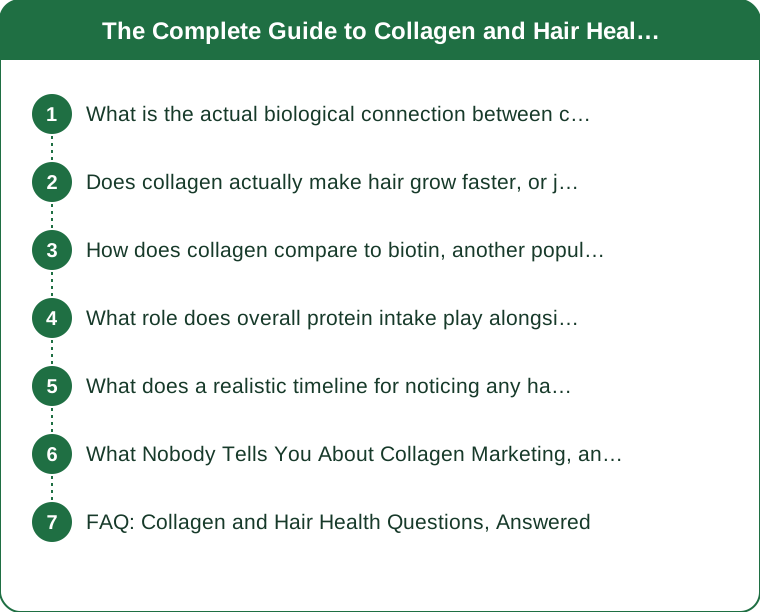
What is the actual biological connection between collagen and hair?
Hair itself is made primarily of keratin, a different protein than collagen, but collagen breaks down during digestion into amino acids — including proline and glycine — that are also building blocks the body can use to synthesize keratin. This means collagen supplementation provides raw material that supports keratin production, without being a direct precursor to hair itself.
This distinction matters because it explains why collagen’s hair benefits are indirect and dependent on overall protein sufficiency, rather than collagen acting as a targeted “hair growth” compound the way some marketing implies.
Does collagen actually make hair grow faster, or just look different?
Current evidence doesn’t strongly support collagen dramatically accelerating hair growth rate specifically; where people report benefits, it’s more commonly around hair thickness, shine, or reduced breakage rather than faster growth from the follicle itself.
This distinction is worth understanding because it’s the difference between a supplement supporting the health and resilience of existing hair versus one that changes how fast new hair is produced — the evidence leans more toward the former.
How does collagen compare to biotin, another popular hair supplement?
Biotin is a vitamin directly involved in keratin infrastructure production and is more specifically studied for hair-related benefits, particularly in people with an actual biotin deficiency (which is relatively uncommon in typical diets), while collagen works more generally by supporting overall amino acid and protein sufficiency.
For someone with a confirmed biotin deficiency, biotin supplementation likely offers more targeted benefit; for general hair health support without a specific deficiency, collagen’s broader amino-acid contribution may be more relevant, though neither is a guaranteed dramatic fix for hair concerns with other underlying causes (hormonal, nutritional, or genetic).

What role does overall protein intake play alongside collagen specifically?
Hair follicles are among the more metabolically active tissues in the body and are highly sensitive to overall protein and nutrient sufficiency — inadequate total protein intake can measurably affect hair growth and shedding regardless of any specific supplement taken on top of it.
This means collagen supplementation without adequate overall dietary protein is unlikely to produce noticeable hair benefits; collagen works best as a component of an already-sufficient protein intake, not a substitute for it.
What does a realistic timeline for noticing any hair-related change look like?
Hair growth cycles are slow — a single hair follicle’s growth phase lasts months, and visible changes in existing hair (thickness, shine, texture) from any supplement, including collagen, typically take at least 8-12 weeks of consistent use to become noticeable, if they appear at all.
Expecting visible results within days or a couple weeks, as some marketing implies, sets an unrealistic bar that doesn’t match how hair biology actually works, regardless of which supplement is involved.
What Nobody Tells You About Collagen Marketing, and What to Consider Before Starting
Many before-and-after collagen marketing photos for hair benefit from lighting, styling, and photo angle differences that exaggerate the actual supplement effect — this doesn’t mean collagen does nothing, but it means the visual “proof” commonly used in marketing isn’t a reliable way to judge realistic expected results.
A more honest framing: collagen is a reasonable, low-risk addition to a broader hair-supportive approach (adequate protein, iron, and vitamin D, since deficiencies in any of these can also cause hair thinning) rather than a standalone solution to a hair concern with an unaddressed underlying cause.
Are there any downsides before starting collagen for hair?
Collagen supplements are generally well-tolerated, though mild digestive discomfort is possible for some people when starting, and it’s worth checking supplement sourcing and third-party testing given the largely unregulated supplement market. If hair thinning is sudden, severe, or accompanied by other symptoms, it’s worth ruling out underlying causes (thyroid issues, iron deficiency, hormonal shifts) with a doctor rather than assuming a supplement alone will resolve it.
FAQ: Collagen and Hair Health Questions, Answered
How much collagen should I take for hair health specifically?
Most studies use doses in the 2.5-10 gram range daily; there’s no strong evidence that dramatically higher doses produce proportionally greater hair benefits specifically.
Should I take collagen or biotin if I have to pick one?
If you suspect an actual biotin deficiency, biotin may offer more targeted benefit; otherwise, collagen’s broader amino-acid support and additional (skin, joint) benefits make it a reasonable general choice.
Can collagen supplements cause hair loss instead of helping?
There’s no established mechanism by which collagen supplementation would cause hair loss; if hair loss occurs after starting a supplement, it’s more likely coincidental with another cause worth investigating separately. This is general information, not medical advice.
TL;DR:
- Collagen provides amino acids that indirectly support keratin production, not a direct hair-growth stimulant
- Evidence supports thickness and resilience benefits more than faster growth from the follicle
- Collagen works best alongside adequate overall protein, not as a substitute for it
- Realistic timelines run 8-12+ weeks — faster visible change isn’t well supported by hair biology
Collagen is a reasonable, low-risk piece of a broader hair-health approach — just not the standalone dramatic fix that marketing photos tend to imply. This is general information, not medical advice.
Keep Reading
This article is for general informational purposes only and is not medical advice. Always consult a qualified health professional for guidance specific to you.