The Collagen and Gut Health Connection: What the Research Actually Supports (And What It Doesn't Yet)
Quick Answer: Collagen contains glycine and glutamine, amino acids theoretically supportive of gut lining integrity, but direct clinical evidence that collagen supplements meaningfully improve gut health or conditions like leaky gut in humans remains limited — most current support is mechanistic and preliminary rather than conclusively proven.
Walk into any wellness space right now and you’ll see collagen marketed for gut health nearly as often as skin and joints. The actual research picture is more nuanced than the marketing copy suggests.

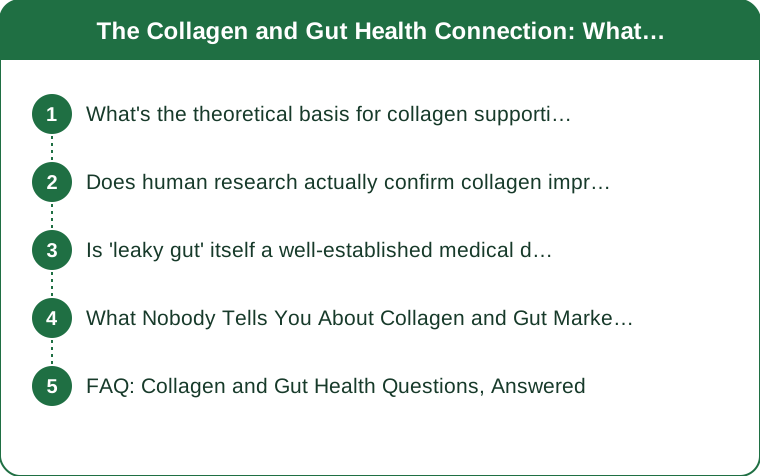
What’s the theoretical basis for collagen supporting gut health?
Collagen is rich in glycine and glutamine, amino acids that play roles in maintaining the intestinal lining’s structural integrity in laboratory and some animal research. The theory is that supplementing collagen could provide raw material supporting gut lining repair and reducing intestinal permeability — commonly referred to as “leaky gut” in popular wellness discussion.
This mechanistic reasoning is genuinely plausible, but plausible mechanism and proven clinical outcome in humans are two different things.
Does human research actually confirm collagen improves gut health outcomes?
Direct, large-scale human clinical trials specifically testing collagen supplementation for gut health outcomes are still limited. Some smaller studies and glutamine-specific research (glutamine is also available as its own standalone supplement) show promising signals, but robust, well-controlled trials isolating collagen’s specific effect on gut health in humans are not yet extensive.

Is ‘leaky gut’ itself a well-established medical diagnosis?
“Leaky gut syndrome” as a standalone diagnosis is not a formally recognized medical condition in the same way conditions like Crohn’s disease or celiac disease are, though increased intestinal permeability is a real, measurable phenomenon studied in various conditions — the popular wellness framing of “leaky gut” often extends well beyond what current research firmly establishes.
What Nobody Tells You About Collagen and Gut Marketing
Here’s the part supplement marketing tends to skip: most gut-health claims for collagen supplements rely on the individual amino acid research (glycine, glutamine) rather than clinical trials of collagen supplementation itself. That’s not necessarily dishonest, but it’s an important distinction — the amino acids in collagen may have gut-supportive properties on their own, which isn’t the same as proving the collagen supplement, as a whole product, delivers a clinically confirmed gut-health benefit.
FAQ: Collagen and Gut Health Questions, Answered
Should someone with a diagnosed digestive condition try collagen for gut health?
This should be discussed with a doctor or gastroenterologist specifically, since digestive conditions vary widely and collagen supplementation isn’t a substitute for medical treatment of diagnosed conditions. This is general information, not medical advice.
Are there any downsides to trying collagen for potential gut benefits?
Collagen is generally well-tolerated by most people, though some report mild digestive discomfort when starting, and it shouldn’t replace any prescribed digestive treatment or be assumed to resolve significant digestive symptoms.
Is bone broth a reasonable alternative to collagen supplements for gut health?
Bone broth contains collagen along with other nutrients and has a similar mechanistic rationale, though it also lacks robust human clinical trials specifically confirming gut-health benefits — it’s a reasonable dietary choice but not a proven gut-health treatment either.
TL;DR:
- Collagen’s glycine and glutamine content offers a plausible mechanism for gut lining support
- Direct human clinical trials specifically confirming collagen’s gut-health benefits remain limited
- “Leaky gut syndrome” isn’t a formally established medical diagnosis, despite common wellness framing
- Most gut-health marketing leans on amino-acid research rather than whole-supplement clinical trials
This is general information, not medical advice — talk to a doctor about any diagnosed digestive condition rather than relying on supplements alone.
Keep Reading
This article is for general informational purposes only and is not medical advice. Always consult a qualified health professional for guidance specific to you.