The Complete Timeline: What Collagen Supplements Actually Do to Skin Over 12 Weeks
Quick Answer: Studies tracking collagen supplementation on skin typically show measurable changes starting around week 4-8, with the more noticeable improvements in elasticity and hydration appearing by week 12. It is a slow-build supplement, not a fast one.
The collagen aisle promises glowing, plumper skin, but rarely tells you the actual timeline behind those claims. Here’s what tracked research on oral collagen supplementation actually found, broken into the phases where change tends to show up.

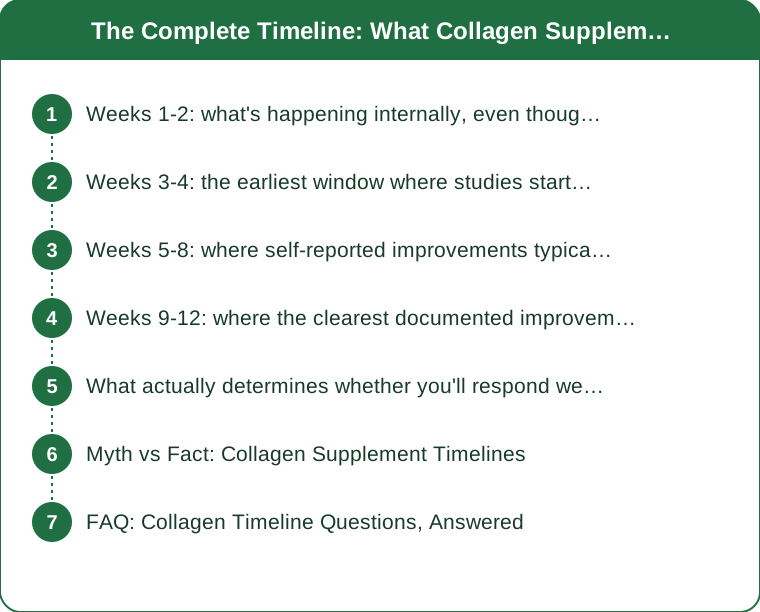
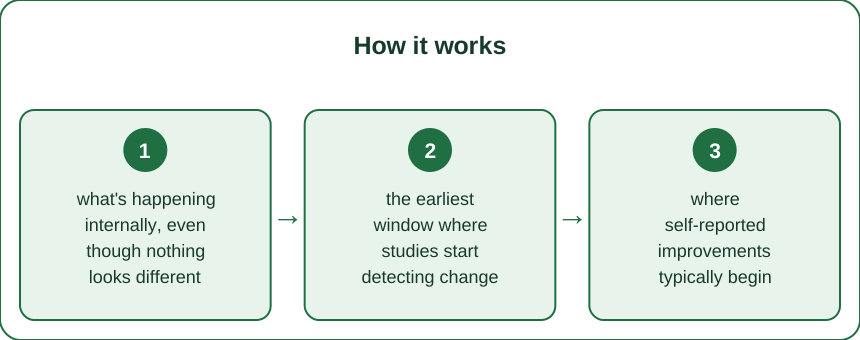
Weeks 1-2: what’s happening internally, even though nothing looks different yet
Ingested collagen is broken down into peptides and amino acids during digestion — it doesn’t travel to your skin as intact collagen. Some of those peptides act as signals that may stimulate your body’s own collagen and elastin production, but that signaling process takes time to translate into visible change.
Expect zero visible difference in this window. This is the phase where people most often quit, assuming the supplement ‘isn’t working’ — but studies consistently don’t measure change this early either.
Weeks 3-4: the earliest window where studies start detecting change
Some research using tools like skin hydration meters (not just visual assessment) has detected small measurable increases in skin moisture starting around this window. This typically isn’t something you’d notice yourself yet — it shows up on instruments before it shows up in the mirror.
If you’re tracking your own experience, this is a good point to start taking a consistent reference photo (same lighting, same angle) weekly, since you won’t reliably remember what week 1 looked like by week 8.
Weeks 5-8: where self-reported improvements typically begin
This is the window where multiple studies on collagen peptides start showing statistically meaningful improvements in skin elasticity and hydration compared to placebo groups. Participants in several trials began self-reporting a difference in skin ‘bounce back’ and smoothness around week 6-8.
This doesn’t mean dramatic transformation — the effect sizes in most studies are modest, not the before/after extremes shown in marketing images. Think ‘noticeably more hydrated’ rather than ‘ten years younger.‘

Weeks 9-12: where the clearest documented improvements appear
The 12-week mark is where most collagen skin studies conclude, and it’s where the most consistent, statistically supported improvements in elasticity and wrinkle depth appear across the research. This is also roughly the point where your own reference photos, if you’ve been taking them, should show a comparison worth evaluating honestly.
If you see genuinely no change in hydration or elasticity by week 12 with consistent daily use, that’s a fair point to reassess whether this supplement is doing anything for you specifically — individual response varies.
What actually determines whether you’ll respond well?
Age is a factor — collagen production naturally declines from your mid-20s onward, and people starting supplementation later sometimes have more room for measurable improvement than someone whose baseline collagen production is still high.
Consistency matters more than dose size within reason — daily use across the full 12 weeks in studies outperforms sporadic higher doses. Sun exposure and smoking both actively break down collagen, so a supplement fighting against continued unprotected sun exposure has a harder job than one paired with daily SPF.
Myth vs Fact: Collagen Supplement Timelines
Myth: You’ll see results within a week or two if the product is good. Fact: No published research supports meaningful skin change that fast — the biological process of stimulating new collagen production simply takes longer than that, regardless of product quality.
Myth: If it’s not working by week 12, it never will. Fact: Some studies extend to 6+ months with continued gradual improvement — 12 weeks is where research commonly stops measuring, not necessarily where the ceiling is.
Myth: Higher doses work proportionally faster. Fact: Most studies use standardized doses (2.5-10g depending on the study) and don’t show a clear faster-is-better pattern beyond that range — consistency at a reasonable dose outperforms an inconsistent high dose.
FAQ: Collagen Timeline Questions, Answered
Do collagen supplements work the same for everyone?
No — age, baseline skin condition, sun exposure habits, and diet all affect individual response, which is why some people notice a clear difference by week 8 and others need the full 12 weeks or longer.
Should you take collagen with food or on an empty stomach?
Either generally works for absorption, though some people find it gentler on digestion taken with a meal — this is more about personal comfort than an established effectiveness difference.
Can you stop and restart collagen without losing progress?
Gradual discontinuation likely means gradual return toward baseline production levels rather than an immediate loss, though there isn’t strong research specifically on stop-restart cycles — consistent daily use remains the best-studied approach.
TL;DR:
- Weeks 1-2: internal signaling only, nothing visible — this is where most people quit too early
- Weeks 5-8: where self-reported hydration and elasticity improvements typically begin
- Weeks 9-12: where the clearest research-documented changes show up
- Consistency and sun protection matter more than dose size for actual results
This is general information, not medical advice — persistent skin concerns are worth discussing with a dermatologist alongside any supplement routine.
Keep Reading
This article is for general informational purposes only and is not medical advice. Always consult a qualified health professional for guidance specific to you.